Introduction
Platelet‑Rich Plasma (PRP) is an autologous concentration of a patient’s own platelets, harvested by a small blood draw and centrifugation. The resulting plasma is rich in growth factors such as PDGF, TGF‑β, and VEGF, which stimulate collagen synthesis, angiogenesis, and tissue remodeling. Hyaluronic‑acid dermal fillers, on the other hand, provide immediate volumetric correction by physically augmenting soft‑tissue compartments and smoothing static wrinkles. Combining PRP with fillers leverages both mechanisms: the filler restores lost volume instantly, while PRP jump‑starts the body’s natural regenerative processes, enhancing collagen density, skin elasticity, and overall texture. This synergistic approach can prolong filler longevity, improve surface quality, and deliver a more natural, gradual rejuvenation with minimal downtime, and a higher patient satisfaction rate across diverse skin types.
Mechanism and Synergy
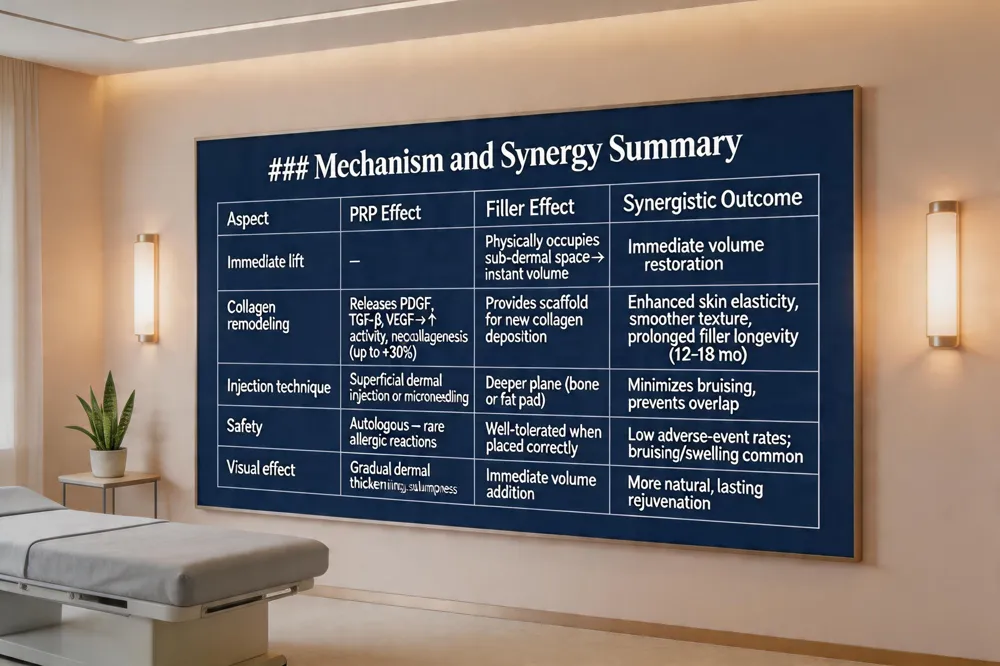
Mechanism and Synergy Summary
| Aspect | PRP Effect | Filler Effect | Synergistic Outcome |
|---|---|---|---|
| Immediate lift | – | Physically occupies sub‑dermal space → instant volume | Immediate volume restoration |
| Collagen remodeling | Releases PDGF, TGF‑β, VEGF → ↑ fibroblast activity, neocollagenesis (up to +30%) | Provides scaffold for new collagen deposition | Enhanced skin elasticity, smoother texture, prolonged filler longevity (12‑18 mo) |
| Injection technique | Superficial dermal injection or microneedling | Deeper plane (bone or fat pad) | Minimizes bruising, prevents overlap |
| Safety | Autologous → rare allergic reactions | Well‑tolerated when placed correctly | Low adverse‑event rates; mild bruising/swelling common |
| Visual effect | Gradual dermal thickening, subtle plumpness | Immediate volume addition | More natural, lasting rejuvenation |
 Platelet‑rich plasma (PRP) is an autologous concentrate of platelets that releases growth factors such as PDGF, TGF‑β and VEGF. These molecules stimulate fibroblast activity, neocollagenesis, elastin production and angiogenesis, leading to thicker, more elastic dermis and improved skin texture. Dermal fillers—most commonly hyaluronic‑acid (HA) gels—work by physically occupying sub‑dermal or supraperiosteal compartments, instantly restoring lost volume and smoothing deep wrinkles.
When PRP is applied before or after filler placement, the two modalities act synergistically. The filler provides immediate structural lift, while PRP’s growth factors remodel the surrounding extracellular matrix, increasing collagen density by up to 30 % and extending filler longevity from the typical 6‑12 months to 12‑18 months in many patients. This “regenerative boost” improves skin elasticity, tone and fine‑line attenuation around the filler, resulting in a more natural, lasting rejuvenation.
Can PRP and dermal fillers be used together safely? Yes. When performed by an experienced injector, the filler is placed first in the deeper plane (bone or fat pad) and PRP is injected or microneedled superficially in the dermis, preventing overlap and minimizing bruising. Patients should avoid blood‑thinners and follow standard post‑care (no heat, vigorous exercise for 24 hours). Studies and split‑face trials report low adverse‑event rates.
What side effects can occur when PRP is combined with fillers? Typical side effects are mild bruising, swelling and tenderness at the injection sites. Because PRP is autologous, allergic reactions are rare. Improper technique can lead to filler migration, uneven contour, or small nodules, but these resolve with conservative management. Strict aseptic technique minimizes infection risk.
Does PRP make the face look fuller? PRP does not add volume like fillers, but its collagen‑stimulating effect thickens the dermis and improves elasticity, giving the skin a subtly plumped, smoother appearance. The fullness is indirect and gradual, noticeable after a series of treatments rather than instantly.
Clinical Outcomes and Expected Results
Clinical Outcomes & Expected Results
| Timeline | Expected Changes | Duration / Longevity |
|---|---|---|
| Immediate (0‑1 day) | Mild redness, swelling; subtle radiance boost | Resolves 2‑3 days |
| 1‑7 days | Tightening sensation, early collagen tightening | Visible texture improvement by day 7 |
| 1‑4 weeks | Fine lines soften, elasticity improves, brighter complexion | Effects continue to develop |
| 3‑6 months | Cumulative collagen remodeling, dark‑circle lightening (30‑50 %), acne‑scar texture reduction | Results peak |
| 6‑12 months | Sustained skin quality; filler longevity extended when combined with PRP | Maintenance needed to prolong |
| Under‑eye PRP alone | Dermal thickening, circle lightening, smoother texture | Benefits last 6‑12 months |
| PRP + HA lip filler | Immediate volume + collagen‑stimulated lip fullness, reduced swelling | Enhanced lip contour lasting beyond filler alone |
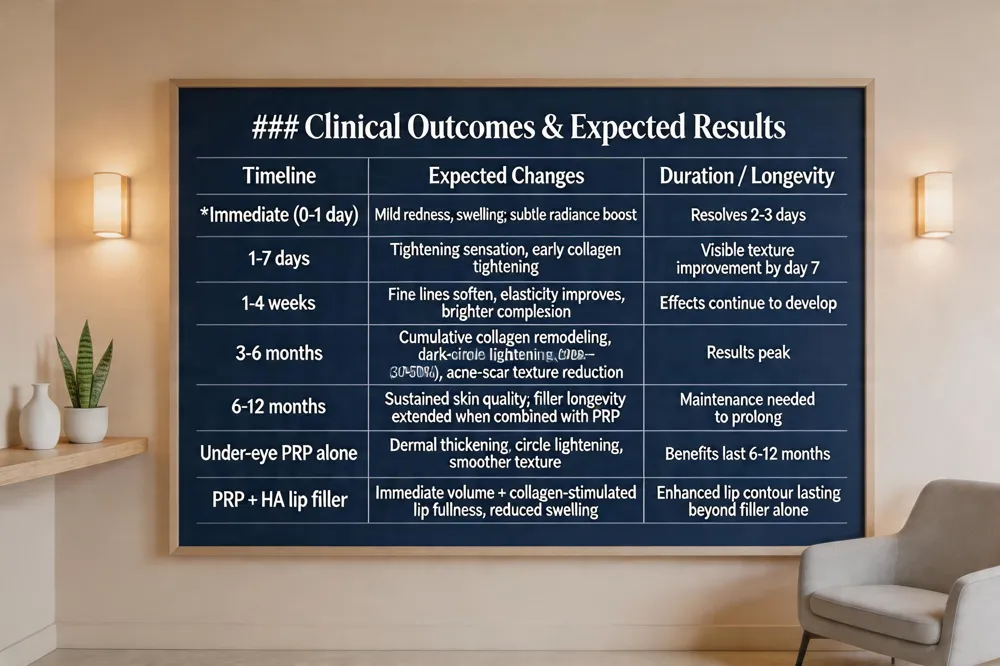 A single PRP facial delivers an immediate, subtle boost of radiance and smoother texture as the autologous growth‑factors collagen and elastin synthesis. Within the first week patients notice a mild tightening sensation and a modest reduction in fine lines; mild redness or swelling resolves in a few days. Clinical trials have measured up to a 30 % increase in dermal collagen density after one session, giving the skin a brighter, refreshed appearance.
After three PRP sessions spaced 4‑6 weeks apart the cumulative effect becomes more pronounced: fine lines and wrinkles visibly soften, skin elasticity improves, and the complexion appears brighter and more even. Collagen remodeling continues for months, often lightening dark circles by 30‑50 % and reducing acne‑scar texture. Results typically last 6‑12 months when a proper skincare routine is maintained.
Under‑eye rejuvenation follows the same pattern. Before treatment the area is dull, thin, and may show dark circles and fine lines. Post‑treatment the skin thickens, circles lighten, and texture smooths, with full benefits evident at 3‑6 months.
When PRP is combined with hyaluronic‑acid lip filler, the filler provides immediate volume while PRP stimulates collagen around the lips. The result is a fuller, hydrated, and naturally soft lip contour with reduced fine lines and faster resolution of swelling and bruising, extending the aesthetic benefit beyond filler alone.
Treatment Protocols and Timing
Treatment Protocols & Timing
| Procedure | Timing Relative to PRP | Key Notes |
|---|---|---|
| Botox | Botox first → PRP (microneedling or superficial injection) 24 hr later (or up to 1 wk if swelling) | Instant wrinkle relaxation + PRP texture boost |
| PRP + Dermal Filler | Filler placed first (deep plane) → PRP injected or microneedled superficially | Prevents overlap, minimizes bruising |
| Standard PRP Series | 3 sessions spaced 4‑6 weeks apart (minimum) | Often sufficient for initial improvement |
| Optimal PRP Series | 4‑6 sessions spaced 4‑6 weeks, then maintenance every 4‑6 months | Maximizes long‑term rejuvenation |
| Combined PRP + Filler | Initial filler → PRP (same visit) → maintenance filler/PRP every 6‑12 months | Extends filler longevity to 12‑18 months |
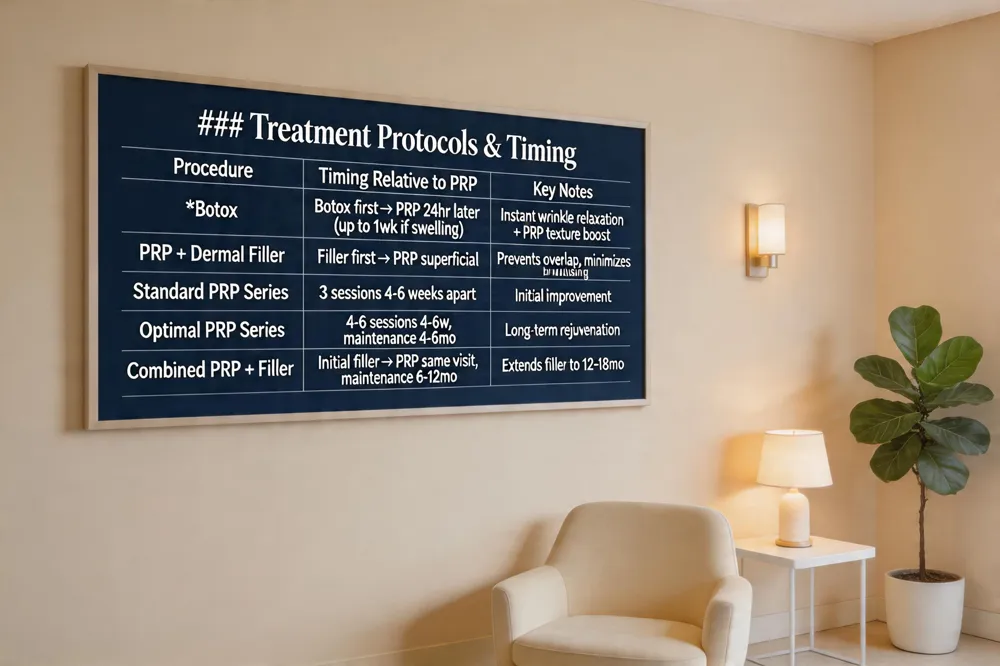 Can Botox be administered at the same time as PRP? Yes. Botox is injected first, followed by PRP microneedling or superficial injections. This synergy yields instant wrinkle relaxation from Botox and longer‑term texture improvement from PRP with only mild, transient erythema.
How long should a patient wait after PRP before receiving Botox? Most clinicians recommend a short 24‑hour interval, though up to one week may be prudent if significant swelling persists after PRP.
Is a three‑session PRP protocol enough for noticeable results? Three sessions spaced 4‑6 weeks apart often produce initial texture improvement, but optimal and lasting rejuvenation usually requires 4‑6 treatments and periodic maintenance every 4‑6 months.
Cost, Availability, and Finding a Provider
Cost, Availability & Provider Guide (Troy, MI)
| Service | Typical Cost (Troy, MI) | Notes |
|---|---|---|
| PRP under‑eye (single session) | $300‑$500 (promo $249) | 2‑3 sessions recommended; package $900‑$1,500 |
| PRP facial (single session) | $350‑$600 | 3‑session package $950‑$1,650 |
| HA lip filler (single) | $500‑$800 (varies by volume) | PRP combo adds collagen benefit |
| Combo PRP + filler | $800‑$1,200 per visit (incl. PRP) | Often bundled in package deals |
| Provider options | Iconic Laser & Aesthetic Center (Troy) – board‑certified PRP‑filler combos; nearby: Dermacare (Birmingham), Skin Solutions (West Bloomfield), The Aesthetic Center (Royal Oak) | Consultation required to tailor treatment |
| US nationwide PRP skin | $300‑$700 per session; microneedling adds $300‑$400 | Cosmetic; not covered by insurance |
 How much does PRP treatment for the under‑eye area cost in Troy, Michigan?
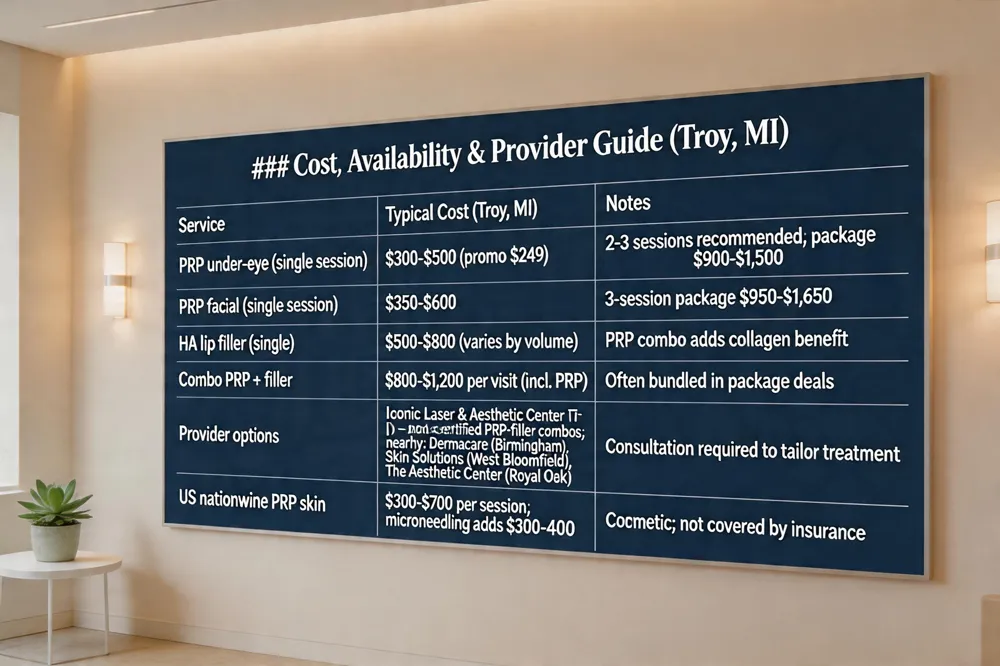
In Troy, a single PRP under‑eye session typically ranges from $300‑$500, with promotional rates as low as $249 (regular $350). Most clinicians recommend 2‑3 sessions spaced 2‑3 months apart; a three‑session package usually totals $900‑$1,500, often with financing or membership discounts.
What is the typical cost of PRP facial treatment in Troy, Michigan?
A PRP facial costs $350‑$600 per visit. Package pricing for three sessions falls between $950‑$1,650, depending on technique (microneedling vs. injection) and add‑ons. PRP is elective and not covered by insurance.
Where can patients find PRP filler services near Troy, Michigan?
Iconic Laser & Aesthetic Center in Troy offers board‑certified PRP‑filler combos. Nearby options include Dermacare (Birmingham), Skin Solutions (West Bloomfield), and The Aesthetic Center (Royal Oak). All require a consultation to tailor treatment.
Is PRP facial treatment available in Troy, Michigan?
Yes. Iconic Laser & Aesthetic Center provides PRP microneedling facials, using autologous plasma to boost collagen, improve tone, and minimize downtime.
What does PRP treatment for skin cost in the United States?
Nationwide, a single skin‑PRP session runs $300‑$700; with microneedling it can reach $600‑$1,000. Packages of 2‑4 sessions lower the per‑visit price, but insurance generally does not cover cosmetic PRP.
Optimizing Results and Maintenance
Optimizing Results & Maintenance
| Recommendation | Details | Frequency |
|---|---|---|
| Cold compress | Apply for first 24‑48 hrs to reduce swelling | Every 2‑3 hrs as needed |
| Gentle skincare | Use mild cleansers, avoid retinoids/acidic peels for 1 wk | Daily |
| Lifestyle | Protein‑rich, antioxidant‑dense diet; stay hydrated; avoid NSAIDs, smoking, excess alcohol | Ongoing |
| Exercise | Light aerobic activity 24‑48 hrs before PRP to improve platelet health | 3‑5 times/week |
| Maintenance schedule | 2‑3 combined PRP‑filler sessions 4‑6 weeks apart; touch‑up filler or PRP every 6‑12 months | As indicated |
| Side‑effect management | Mild redness, swelling, bruising resolve in days; nodules/infection require prompt care | Immediate if symptoms persist |
| Day‑by‑day progression | D1‑2: swelling/redness; D3‑7: inflammation subsides, early tightening; D8‑14: texture improvement; D15‑30: smoother lines; D31‑60: full radiance | N/A |
| Under‑eye PRP longevity | Results last 6‑12 months; extend with maintenance every 6‑9 months | Every 6‑9 months |
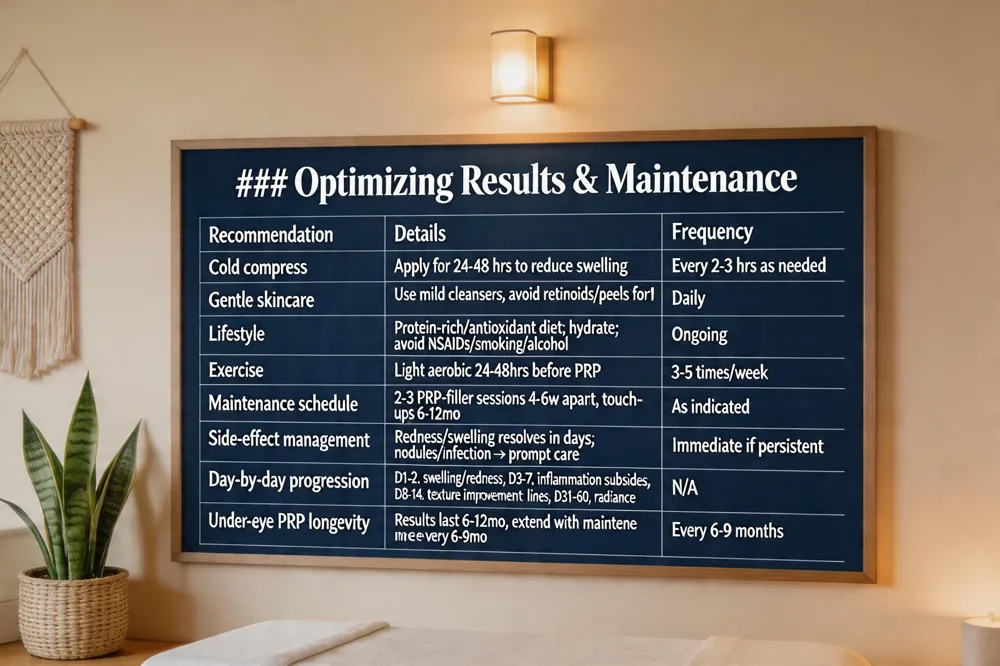 Post‑procedure care is essential for maximizing the benefits of PRP‑plus‑filler treatments. Patients should apply cold compresses for the first 24‑48 hours, keep the area clean, avoid heavy lifting, and use gentle skin‑care products to reduce bruising and swelling. Lifestyle factors that boost PRP efficacy include a protein‑rich, antioxidant‑dense diet, ample hydration, and avoidance of NSAIDs, smoking, and excessive alcohol, all of which support platelet function and collagen synthesis. Regular aerobic exercise before treatment improves red‑blood‑cell health, further enhancing the regenerative response. Maintenance schedules typically involve 2‑3 combined sessions spaced 4‑6 weeks apart, with touch‑up filler or PRP sessions every 6‑12 months to sustain volume and skin quality.
Common side effects: mild redness, localized swelling, bruising, tenderness, and a temporary tight sensation resolve within a few days; rare infection or nodules require prompt care.
Day‑by‑day progression: Day 1‑2 – mild swelling/redness; Day 3‑7 – subsiding inflammation and early collagen tightening; Day 8‑14 – visible texture improvement and gentle lift; Day 15‑30 – continued collagen remodeling, smoother lines; Day 31‑60 – fully established radiance and natural volume lasting 6‑12 months.
Maximizing results: follow a nutrient‑rich diet, stay hydrated, avoid anticoagulants, adhere to after‑care, and schedule recommended maintenance sessions.
Under‑eye PRP longevity: results typically last 6‑12 months; maintenance every 6‑9 months and diligent after‑care can extend benefits.
Conclusion
Combining autologous PRP with hyaluronic‑acid fillers creates a two‑phase rejuvenation: immediate volume from the filler and longer‑term collagen remodeling driven by PRP’s growth factors. Clinical data show up to a 30 % increase in collagen density, a 20‑30 % extension of filler longevity, and higher patient‑satisfaction scores when the modalities are used together. Clinicians stress strict aseptic standards and careful screening to keep the procedure safe. This evidence‑based synergy reshapes the aesthetic field. Emerging research is testing PRP‑infused bio‑scaffolds, AI‑guided injection mapping, and combined laser‑PRP protocols to further enhance outcomes for patients.