Why Modern Scar Camouflage Matters
Visible scars can undermine self‑esteem, causing social anxiety and reluctance to engage in everyday activities. Modern scar camouflage addresses these psychological impacts by offering a discreet, non‑surgical solution that blends scar tissue with surrounding skin. Over the past decade, the field has progressed from invasive surgical revisions to minimally invasive injectable fillers, collagen‑stimulating agents, and paramedical pigment tattooing, each grounded in scientific research and tailored to scar type, depth, and patient skin tone. Premium clinics such as Iconic Laser in Troy, Michigan, combine FDA‑approved products, sterile technique, and board‑certified dermatologists to ensure safety and optimal outcomes. Personalized assessment—considering scar age, texture, and individual goals—guides the selection of the most effective modality, delivering natural‑looking results and restored confidence. Patients benefit from ongoing support and after‑up.
Foundations of Scar Management
Foundations of Scar Management
| Technique | Application | Key Benefits | Typical Duration/Usage |
|---|---|---|---|
| Petroleum jelly / antibacterial ointment | Early wound care | Keeps incision clean, reduces infection risk | Apply 2–3 × daily until re‑epithelialization |
| Silicone sheets or gels | Mature hypertrophic/keloid scars | Moist environment flattens texture, reduces redness | ≥12 h/day for 8–12 weeks |
| Pulsed‑dye / fractional CO₂ laser | Vascular/colored scar reduction | Thins scar, improves pigmentation | 1–3 sessions, 4–6 weeks apart |
| Microneedling (+ PRP) | Collagen remodeling, pigment uptake | Enhances pliability, improves tone | 3–4 sessions, 4 weeks interval |
| Hyaluronic‑acid fillers (e.g., Restylane®, Juvéderm®) | Depressed/atrophic scars | Immediate lift, hydration, smooth surface | 1–2 sessions, 2–4 weeks apart |
| Poly‑L‑lactic acid (PLLA) | Volume restoration & collagen stimulation | Long‑term tissue regeneration, gradual improvement | 2–4 sessions, 4–6 weeks apart |
| Scar massage | All scar types | Improves pliability, reduces thickness | 5–10 min, 2–3 × daily |
| Sun protection (SPF 50+) | Post‑procedure care | Prevents hyperpigmentation | Daily, throughout healing period |
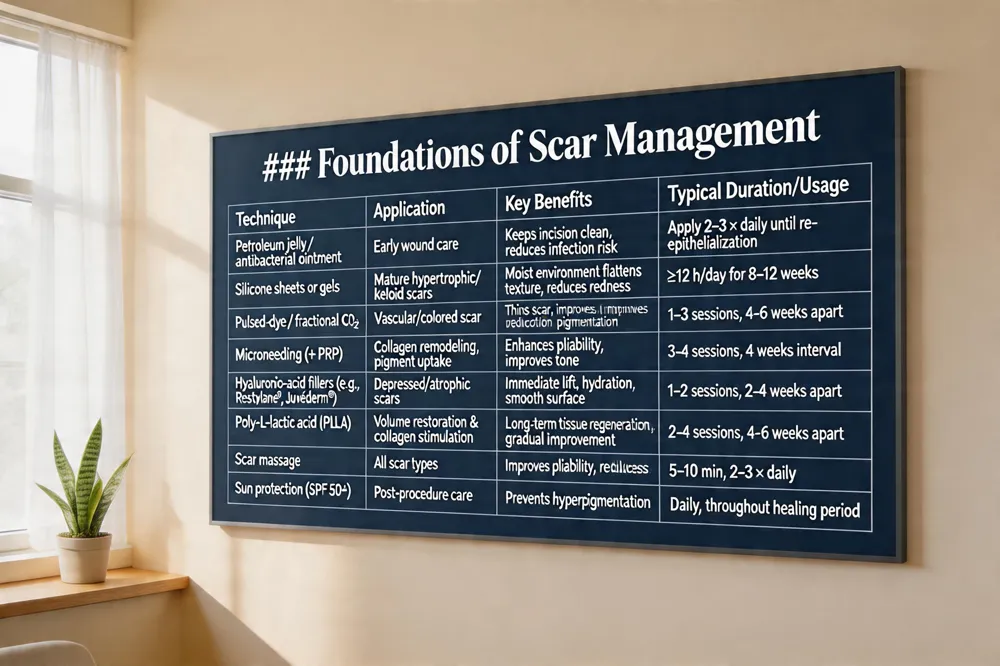 Effective scar management starts with meticulous early wound care: keep the incision clean, apply a thin layer of petroleum jelly or an antibacterial ointment, and protect the area from sun exposure to prevent hyperpigmentation. Hydration is crucial; silicone sheets or gels should be worn for at least 12 hours daily for several weeks, creating a moist environment that flattens texture and reduces redness. For mature hypertrophic or keloid scars, pulsed‑dye and fractional CO₂ laser modalities target excess vascularity and collagen, achieving significant thinning and color improvement when performed by a board‑certified dermatologist. Microneedling—often combined with platelet‑rich plasma—stimulates collagen remodeling and, together with gentle scar massage, enhances pliability and pigment uptake. Depressed or atrophic scars benefit from volumetric correction using hyaluronic‑acid fillers or collagen‑stimulating agents such as poly‑L‑lactic acid, which add immediate lift and promote long‑term tissue regeneration. A personalized regimen that blends these non‑invasive, science‑backed techniques—while adhering to strict sterility, sun protection, and post‑procedure care—delivers the safest and most durable aesthetic outcomes.
Best Injectable for Facial Scar Camouflage
Best Injectable for Facial Scar Camouflage
| Injectable | Indication | Approx. Improvement (%) | Recovery Time |
|---|---|---|---|
| Medical‑grade pigment (micropigmentation) | Color mismatch, visible discoloration | 70‑85 % reduction in visible pigment mismatch | 1‑2 days mild swelling/bruising |
| Hyaluronic‑acid filler (Restylane®, Juvéderm®, Belotero®) | Atrophic/depressed scars | 60‑80 % improvement in depth & texture | 1‑2 days mild swelling/bruising |
| Poly‑L‑lactic acid (PLLA) | Deep volume loss, collagen stimulation | 60‑75 % improvement over 3‑6 months | Minimal; mild erythema 1‑2 days |
| Calcium‑hydroxylapatite (CaHA) | Severe atrophic scars | 55‑70 % improvement | Minimal; transient firmness |
| PRP (autologous) | Texture & pigment enhancement when 30‑50 % improvement (adjunct) | 1‑2 days mild redness | |
| Combination (pigment + HA filler) | Indented + discolored scars | 80‑90 % overall aesthetic result | 1‑2 days post‑procedure recovery |
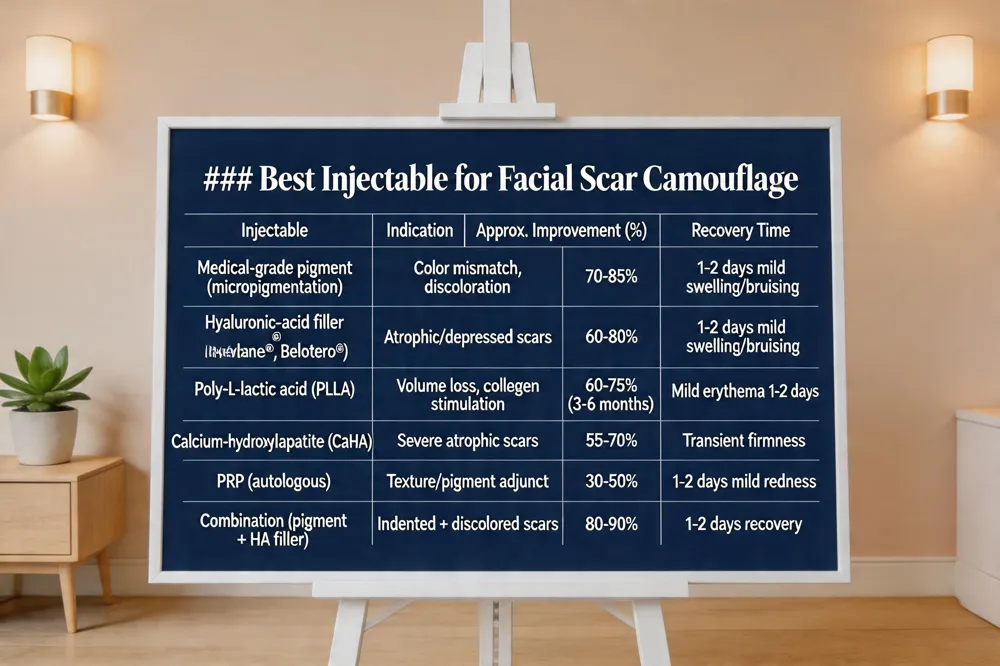 Color‑matching pigment injection (micropigmentation) is the gold‑standard for true scar camouflage on the face. By "tattooing" the scar with a custom‑blended, medical‑grade pigment, the discoloration is neutralized and the scar blends seamlessly with surrounding skin. For atrophic or depressed scars, hyaluronic‑acid fillers such as Restylane®, Juvéderm® or Belotero® add volume, hydrate the tissue, and smooth surface irregularities, yielding a 60‑80 % improvement in depth and texture. When a scar is both indented and discolored, a combined approach—pigment injection for tone and HA filler for depth—delivers the most natural result. These procedures are minimally invasive, require only a brief recovery (typically 1‑2 days of mild swelling or bruising), and demand a board‑certified dermatologist or plastic surgeon with expertise in pigment matching, aseptic technique, and scar assessment. Proper practitioner selection ensures safety, optimal outcomes, and personalized care.
Cost of Injectable Scar Camouflage
Cost of Injectable Scar Camouflage
| Product / Technique | Cost per Session (USD) | Package Cost (2‑4 sessions) | Notes |
|---|---|---|---|
| Hyaluronic‑acid filler | $300‑$500 | $1,200‑$2,000 | Includes pigment formulation if combined |
| Poly‑L‑lactic acid (PLLA) | $500‑$800 | $2,200‑$3,200 | Requires 2‑4 sessions for optimal effect |
| PRP (autologous) | $350‑$600 | $1,400‑$2,400 | Often combined with microneedling |
| Micropigmentation (scar tattoo) | $400‑$700 | $1,600‑$2,800 | Includes patch test & after‑care kit |
| Combination protocol (filler + pigment) | $600‑$900 | $2,400‑$3,600 | Best for indented & discolored scars |
| Laser adjunct (fractional CO₂, PDL) | $250‑$450 per pass | $1,000‑$1,800 (multiple passes) | Separate from injectable fees |
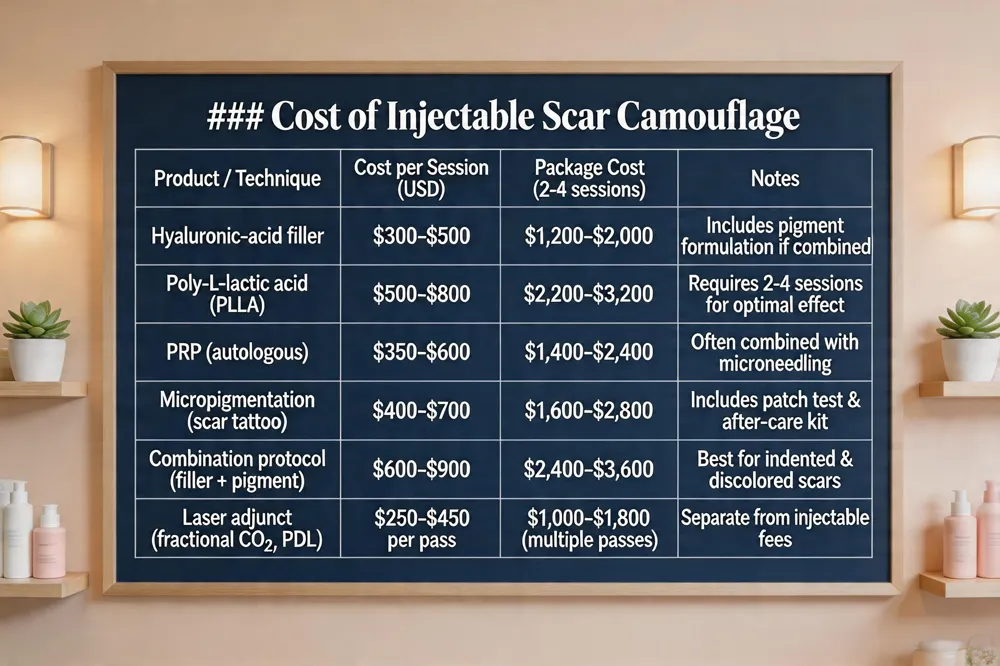 Injectable scar‑camouflage treatments typically range from $300 to $800 per session, depending on the product used (hyaluronic‑acid filler, PLLA, PRP, or corticosteroid) and the size of the treated area. Many clinics offer package deals that bundle 2‑4 sessions—often the number needed for optimal results—at a discounted total of $1,200 to $4,600, which can include custom pigment formulation, post‑procedure care kits, and follow‑up visits. Price drivers include scar location (e.g., facial versus torso), scar volume, the number of injections required, and the provider’s expertise and board certification. Some premium practices provide financing plans or medical‑grade credit cards, and while most insurers consider these procedures cosmetic, they may cover intralesional steroid injections for hypertrophic or keloid scars when deemed medically necessary. A personalized consultation is essential to receive a detailed quote that reflects the specific characteristics of your scar and the recommended treatment plan.
Finding a Scar Camouflage Tattoo Near You
Finding a Scar Camouflage Tattoo Near You
| Clinic | Location | Services | Notable Features | Financing |
|---|---|---|---|---|
| Iconic Laser | Troy, Michigan | Paramedical micropigmentation, scar assessment | FDA‑approved pigments, digital skin‑tone measurement, patch‑test, sterile single‑use needles | Payment plans, insurance‑compatible billing |
| ScarStudio MD | Los Angeles, CA | Scar tattoo, laser resurfacing | Board‑certified dermatologists, 3‑step after‑care kit | Monthly financing options |
| Dermacraft | Austin, TX | Pigment injection, HA filler, PRP | Same‑day consult, on‑site lab for pigment mixing | Discounted bundles (3 sessions) |
| SkinRevive | Chicago, IL | Microneedling + pigment, laser hybrid | AI‑guided fractional‑laser‑RF system (2026) | Low‑interest medical credit cards |
| BeautyInk Clinic | Miami, FL | Scar camouflage tattoo, anti‑scar sheet therapy | 24‑hour urgent care line, virtual follow‑up | No‑interest 12‑month financing |
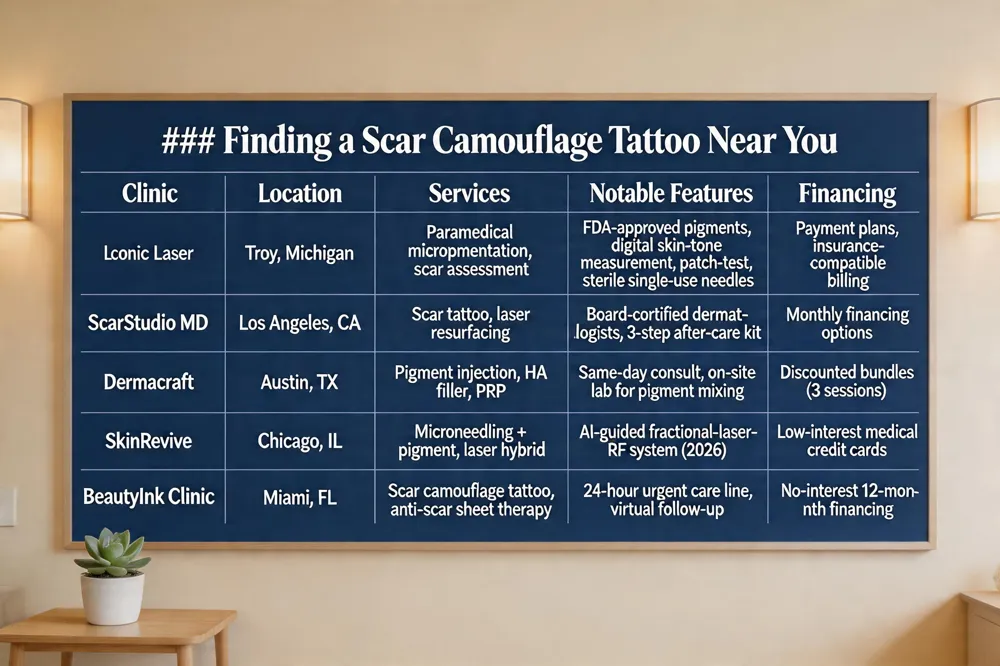 Paramedical micropigmentation, commonly known as scar camouflage tattooing, uses FDA‑approved, medical‑grade pigments deposited with ultra‑fine needles to blend a scar into the surrounding skin tone. In the Troy, Michigan area, Iconic Laser offers this service through board‑certified dermatology‑oriented artists who follow strict sterility protocols and use the latest pigment‑matching technology (e.g., digital skin‑tone measurement devices).
A typical treatment timeline includes an initial consultation, a 1‑2 hour pigment‑placement session, and a follow‑up appointment 4‑6 weeks later to fine‑tune the color and assess healing. After‑care emphasizes gentle cleaning, moisturization, SPF 50+ sunscreen, and avoidance of harsh exfoliants for 2‑3 weeks.
Safety standards at Iconic Laser include a patch‑test, sterile single‑use needles, and comprehensive pre‑ and post‑procedure instructions, minimizing infection risk and adverse reactions. Financing options such as payment plans and insurance‑compatible billing are available to make the procedure accessible.
If you search for “scar camouflage tattoo near me,” Iconic Laser in Troy, Michigan is a reputable, locally‑owned clinic where you can schedule a personalized consultation to determine candidacy, cost, and financing.
Efficacy, Success Rates, and Emerging Techniques
Efficacy, Success Rates, and Emerging Techniques
| Modality | Visible Reduction (%) | Sessions Required | Follow‑up Interval | Patient Satisfaction (out of 10) |
|---|---|---|---|---|
| HA filler + micropigmentation | 70‑85 % | 1‑2 (filler) + 1 (pigment) | 4‑6 weeks after each session | 8.5‑9.0 |
| PLLA (poly‑L‑lactic acid) | 60‑75 % | 2‑4 | 4‑6 weeks between sessions | 8.0 |
| CaHA (calcium‑hydroxylapatite) | 55‑70 % | 2‑3 | 4‑6 weeks | 7.5 |
| PRP + microneedling | 30‑50 % (adjunct) | 3‑5 | 4‑6 weeks | 7.0 |
| Autologous fat grafting | 65‑80 % (volume) | 1‑2 | 6‑8 weeks | 8.0 |
| AI‑guided fractional‑laser‑RF hybrid (2026) | 80‑90 % texture & pigment improvement | 1‑2 | 2‑4 weeks | 9.0‑9.5 (early trials) |
| Combination protocol (filler + microneedling + PRP) | 70‑85 % | 3‑5 | 4‑6 weeks | 8.5 |
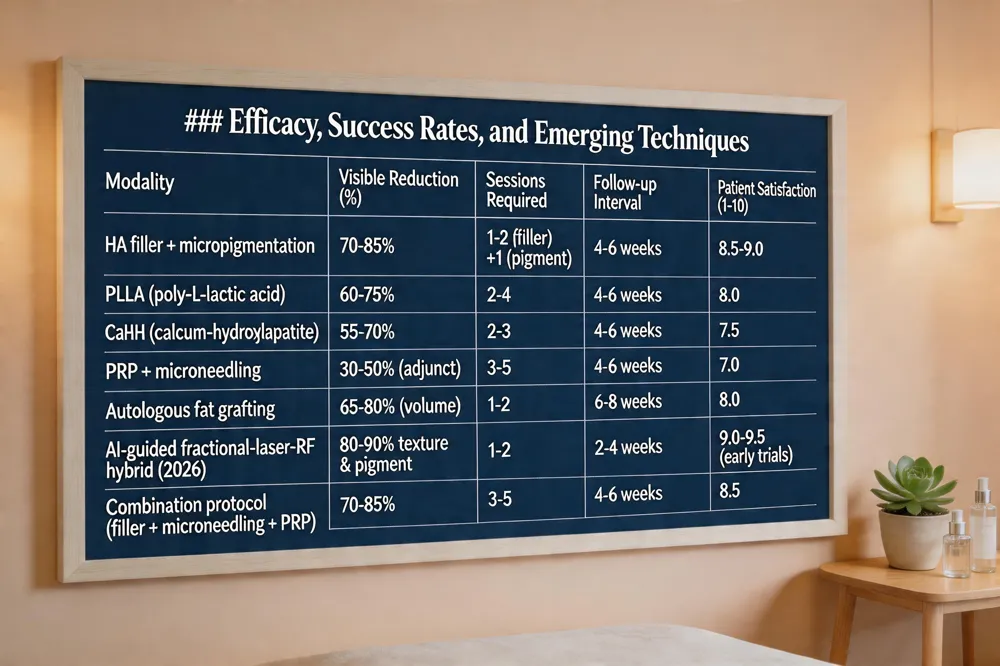 Injectable scar camouflage relies on two high‑performing pillars: hyaluronic‑acid (HA) fillers and micropigmentation (medical tattooing). Clinical series from U.S. dermatology centers report 70‑85 % visible reduction in scar prominence when these techniques are performed by board‑certified clinicians, with patient satisfaction scores averaging 8.5/10. For deeper atrophic or rolling scars, collagen‑stimulating injectables such as poly‑L‑lactic acid (PLLA) and calcium‑hydroxylapatite (CaHA) achieve 60‑75 % improvement by inducing gradual dermal remodeling; the benefit typically materializes over 3‑6 months after 2‑4 sessions spaced 4‑6 weeks apart. PRP, autologous fat grafting, and combination protocols (e.g., filler + microneedling + PRP) further enhance texture and color match, though outcomes are more variable and often require three to five treatments. Recent advances include a 2026 AI‑guided fractional‑laser‑RF hybrid system that maps scar architecture in real time, delivering precise micro‑injuries and controlled heating to accelerate organized collagen repair; early trials show superior texture, pigmentation, and satisfaction versus monotherapy. Overall, a multimodal approach—tailoring injectable volume, pigment, and energy‑based resurfacing—delivers the most consistent, natural‑looking scar camouflage.
Patient Perspectives, Celebrities, and Specialized Applications
Patient Perspectives, Celebrities, and Specialized Applications
| Application | Target Group | Typical Protocol | Benefits | Maintenance |
|---|---|---|---|---|
| Medical‑grade pigment injection (scar tattoo) | All scar types, especially facial | 1‑2 h placement + 4‑6 weeks touch‑up | Immediate color match, natural look | Touch‑up every 12‑18 months |
| HA filler for atrophic scars | Depressed/rolling scars | 1‑2 sessions, 2‑4 weeks apart | Immediate lift, hydration | Re‑treatment every 12‑18 months |
| Areola tattooing post‑mastectomy | Breast cancer survivors | 2‑3 sessions, 4‑6 weeks apart | Restores nipple‑areola complex, improves confidence | Annual color refresh if needed |
| Celebrity scar management (silicone + laser + makeup) | High‑visibility professions | Multi‑modal: silicone sheets → laser → microneedling → makeup | Discreet, long‑lasting results | Seasonal touch‑ups for makeup coverage |
| Scar camouflage for keloids (intralesional steroids + laser) | Hypertrophic/keloid scars | Steroid injection → laser resurfacing (2‑3 sessions) | Reduces volume & redness | Follow‑up every 6 months |
| AI‑guided laser‑RF hybrid (2026) | Early adopters, research participants | Single session with real‑time mapping | Accelerated collagen remodeling, superior texture | Optional touch‑up after 9‑12 months |
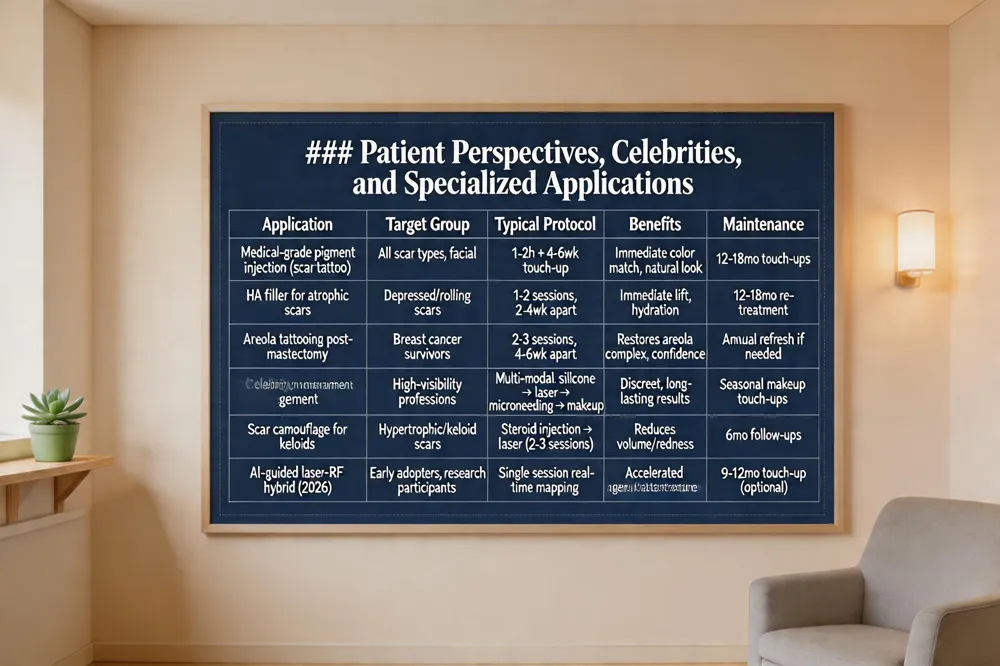 Celebrities keep surgical scars invisible by combining medical and cosmetic tactics: after surgery they use silicone sheets or scar‑reduction creams, schedule laser resurfacing or microneedling to smooth texture and fade discoloration, and rely on professional high‑coverage makeup for public appearances.
Scar camouflage is often worth the investment when performed by a board‑certified aesthetic specialist. The procedure blends the scar with surrounding skin using medical‑grade pigments, delivering a natural look after a 4‑8‑week healing period and eliminating the daily need for concealers. Clients report boosted confidence and high satisfaction scores.
Areola tattooing after mastectomy effectively masks surgical scars, recreating a realistic nipple‑areola complex with custom‑matched pigments.
No modality can guarantee 100 % scar removal; deeper tissue changes remain. Combining lasers, microneedling‑RF, and injectable fillers can achieve dramatic improvement, but residual texture may persist.
Typical scar‑camouflage protocols involve 2‑4 sessions spaced 4‑6 weeks apart, with a final touch‑up 6 weeks after the last treatment. Maintenance touch‑ups every 12‑18 months keep the color stable over time.
Putting It All Together: A Tailored Path to Seamless Skin
First, a thorough assessment of scar type, age, depth, color and the patient’s Fitzpatrick skin tone guides every decision. Atrophic, depressed scars often benefit from hyaluronic‑acid fillers or poly‑L‑lactic acid to restore volume, while hypertrophic or keloid tissue responds better to silicone‑based gels, intralesional steroids, or pigment‑based camouflage tattoos that blend the scar with surrounding skin. Setting realistic expectations means explaining that most patients need 2‑4 sessions spaced 4‑8 weeks apart, that results may take 6‑12 weeks to settle, and that occasional touch‑ups are normal. Choosing a board‑certified Michigan clinic such as Iconic Laser guarantees sterile technique, FDA‑approved products, and experienced physicians who combine injectables with laser or microneedling for optimal, safe outcomes. Personalized after‑care plans, including moisturization and sunscreen, further protect the results.