Why Combine PDO Threads and RF?
PDO thread lifts provide an immediate mechanical lift while stimulating fibroblasts to produce new collagen and elastin over 6‑8 months. Radiofrequency skin tightening delivers controlled heat (43‑47 °C) to the dermis, causing instant collagen contraction and long‑term neocollagenesis. When combined, the threads create a supportive scaffold and the RF energy accelerates collagen remodeling around that scaffold, enhancing skin firmness, elasticity, and contour durability. This synergistic effect yields a more natural, longer‑lasting lift with minimal downtime, making it ideal for mild to moderate facial laxity.
Mechanics of the Dual‑Modality Treatment
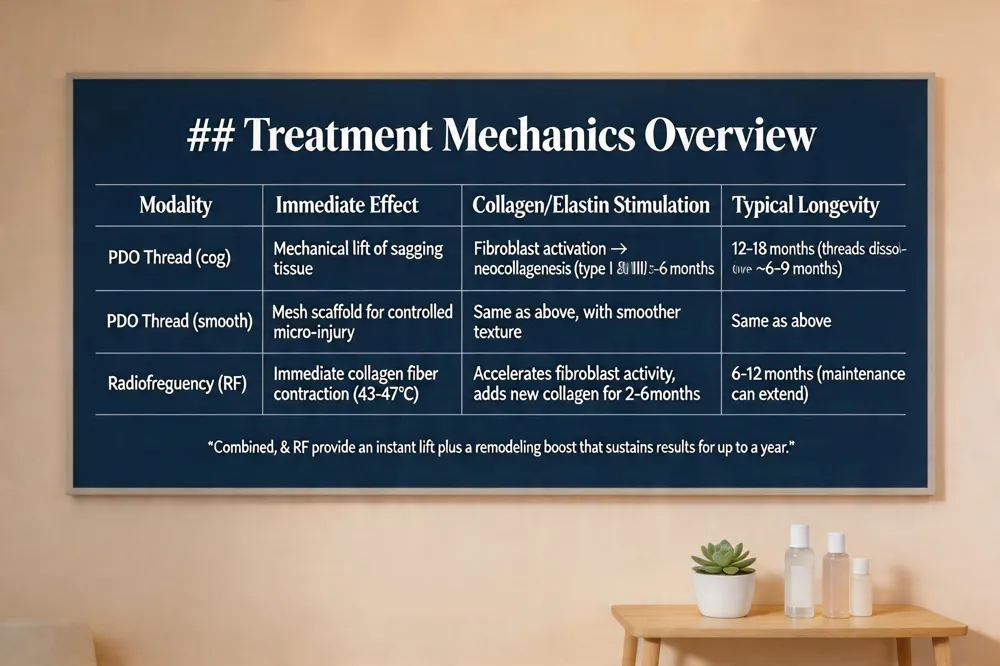
Treatment Mechanics Overview
| Modality | Immediate Effect | Collagen/Elastin Stimulation | Typical Longevity |
|---|---|---|---|
| PDO Thread (cog) | Mechanical lift of sagging tissue | Fibroblast activation → neocollagenesis (type I & III) over 3‑6 months | 12‑18 months (threads dissolve ~6‑9 months) |
| PDO Thread (smooth) | Mesh scaffold for controlled micro‑injury | Same as above, with smoother texture | Same as above |
| Radiofrequency (RF) | Immediate collagen fiber contraction (43‑47 °C) | Accelerates fibroblast activity, adds new collagen for 2‑6 months | 6‑12 months (maintenance can extend) |
Combined, & RF provide an instant lift plus a remodeling boost that sustains results for up to a year.
 When a patient walks in for a nonsurgical facelift, the initial assessment typically reveals mild‑to‑moderate sagging of the cheeks, jawline, or neck, with nasolabial folds, jowls, and marionette lines appearing pronounced. The first step—PDO thread placement—introduces barbed (cog) and smooth (mono) threads beneath the subdermal tissue. Barbed threads anchor in the subcutaneous layer, pulling sagging jowls upward for an immediate mechanical lift, while smooth threads create a mesh that triggers a controlled micro‑injury. This micro‑injury initiates fibroblast activation, leading to neocollagenesis, elastin synthesis, and even hyaluronic acid production over the next 3‑6 months. Patients notice a visible lift within days, and the newly formed collagen matrix can sustain the effect for 12‑18 months after the threads dissolve (≈ 6‑9 months).
Following thread insertion, radiofrequency (RF) skin‑tightening is applied. RF delivers focused thermal energy (43‑47 °C) to the deep dermis, causing immediate collagen fiber contraction and stimulating fibroblasts to produce new type I and III collagen. The thermal boost accelerates the remodeling already set in motion by the threads, enhancing skin firmness and elasticity. Clinical data show RF‑induced collagen remodeling continues for 2‑6 months, with results lasting six to twelve months and maintenance sessions extending durability.
PDO thread lift before and after: Before treatment, patients exhibit sagging and defined folds; after thread placement, an instant lift is seen, and over 3‑6 months collagen matures, delivering smoother, firmer skin for up to a year.
How long does the RF face lift last? RF tightening typically offers benefits for six months to a year, with ongoing firmness up to twelve months; periodic touch‑ups every 2‑3 months can prolong the effect.
RF skin tightening before and after: Pre‑treatment skin shows laxity, fine lines, and uneven texture; post‑treatment, the dermis contracts, yielding smoother, tighter, and more contoured skin that continues to improve for 3‑6 months.
Cost, Value, and Managing Expectations
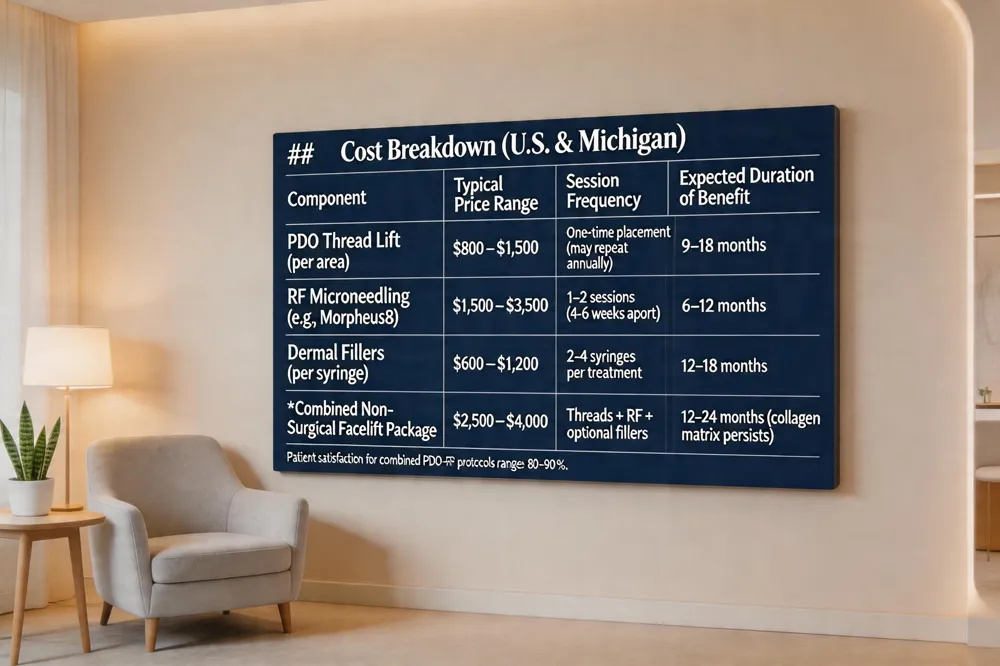
Cost Breakdown (U.S. & Michigan)
| Component | Typical Price Range | Session Frequency | Expected Duration of Benefit |
|---|---|---|---|
| PDO Thread Lift (per area) | $800 – $1,500 | One‑time placement (may repeat annually) | 9‑18 months |
| RF Microneedling (e.g., Morpheus8) | $1,500 – $3,500 | 1‑2 sessions (4‑6 weeks apart) | 6‑12 months |
| Dermal Fillers (per syringe) | $600 – $1,200 | 2‑4 syringes per treatment | 12‑18 months |
| Combined Non‑Surgical Facelift Package | $2,500 – $4,000 | Threads + RF + optional fillers | 12‑24 months (collagen matrix persists) |
Patient satisfaction for combined PDO‑RF protocols ranges 80‑90 %.
Pricing for PDO Thread Lifts in Troy, Michigan
At premium aesthetic clinics in Troy, Michigan, PDO thread lift prices typically range from $800 to $1,500 per treated area. Simpler zones such as the jawline or neck fall at the lower end, while multi‑zone or high‑density barbed treatments are priced toward the higher end. The exact cost depends on the number of threads, thread type (smooth, cog, or screw), and the complexity of the lift. During a personalized consultation you will receive a detailed quote, and many clinics offer financing options to make the investment in confidence more manageable.
Overall Cost of a Non‑Surgical Facelift Package
A comprehensive non‑surgical facelift that combines PDO threads, RF microneedling, and optional dermal fillers generally totals $2,500‑$4,000 in the United States, with Michigan pricing near the national lower‑mid range. Individual components break down as follows: PDO thread lift $800‑$1,500 per area, RF microneedling (e.g., Morpheus8) $1,500‑$3,500 per session, and dermal fillers $600‑$1,200 per syringe (most patients use two‑to‑four syringes). When bundled, the package offers a synergistic lift and long‑lasting skin tightening that can rival the aesthetic outcomes of surgical facelifts at a fraction of the downtime and cost.
Common Side‑Effects and Patient Satisfaction
RF facial sculpting and PDO threading are well‑tolerated. Typical short‑term reactions include redness, mild swelling, and a tingling sensation that resolve within 24‑48 hours; occasional bruising or tiny crusts may appear. Rare complications—burns, scarring, fat loss, or nerve irritation—are usually linked to aggressive settings or inexperienced providers. Proper after‑care (gentle moisturizers, sun protection, avoiding picking) minimizes discomfort and promotes smooth recovery. Patient satisfaction scores for combined PDO‑RF treatments range from 80‑90 %, reflecting high perceived value when results are explained clearly and expectations are set realistically.
Real‑World Results: Before‑and‑After Transformations
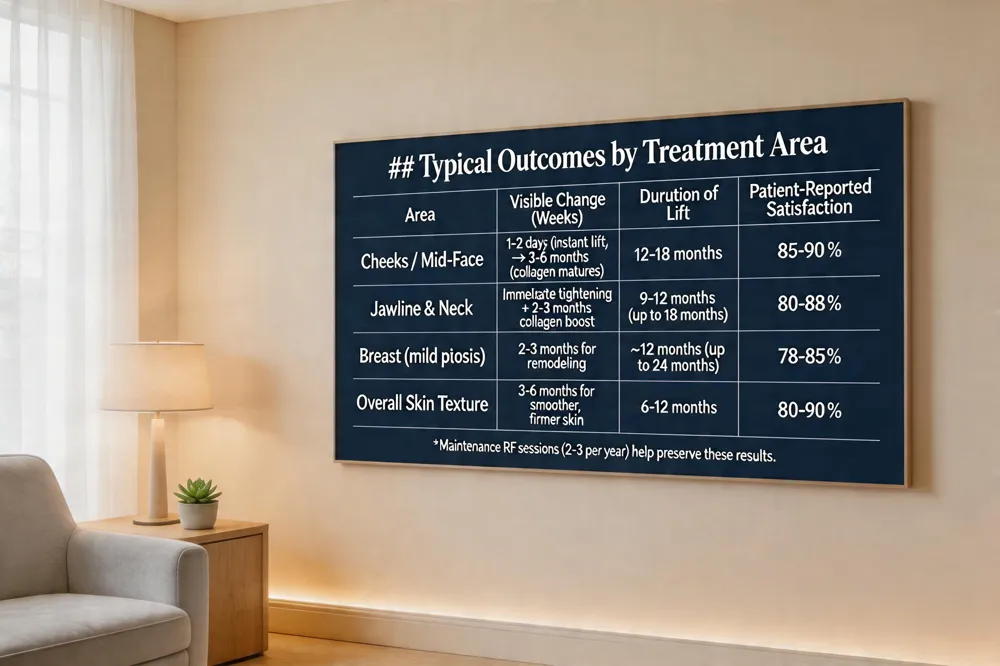
Typical Outcomes by Treatment Area
| Area | Visible Change (Weeks) | Duration of Lift | Patient‑Reported Satisfaction |
|---|---|---|---|
| Cheeks / Mid‑Face | 1‑2 days (instant lift) → 3‑6 months (collagen matures) | 12‑18 months | 85‑90 % |
| Jawline & Neck | Immediate tightening + 2‑3 months collagen boost | 9‑12 months (up to 18 months) | 80‑88 % |
| Breast (mild ptosis) | 2‑3 months for remodeling | ~12 months (up to 24 months) | 78‑85 % |
| Overall Skin Texture | 3‑6 months for smoother, firmer skin | 6‑12 months (RF) | 80‑90 % |
Maintenance RF sessions (2‑3 per year) help preserve these results.
 RF facial sculpting delivers a noticeable lift and texture improvement after a series of 3‑6 sessions. Patients typically start with mild‑to‑moderate laxity, fine lines, and a soft jawline. Post‑treatment photos taken 6‑12 weeks later show firmer, smoother skin, tighter cheeks, a more defined chin and jawline, and softened texture irregularities. Maintenance RF sessions help preserve these gains.
A PDO thread lift for the neck uses absorbable sutures placed beneath the skin to instantly tighten sagging tissue and trigger collagen production. The minimally invasive procedure, performed under local anesthesia in under an hour, allows patients to resume daily activities the same day. Results are subtle, natural‑looking, and typically last 9‑12 months (up to 18 months in select cases), making it ideal for mild‑to‑moderate horizontal neck lines or early platysmal banding.
PDO thread lifts can also address mild breast ptosis. Barbed threads are inserted under local anesthesia to reposition tissue and stimulate collagen remodeling. Visible improvement appears within 2‑3 months, with results lasting about a year and sometimes up to two years as the newly formed collagen matrix matures. This option suits women up to D‑cup size seeking a non‑surgical lift.
Comprehensive facial contouring combines dermal fillers for volume, neuromodulators to slim the masseter, and energy‑based devices such as RF or ultrasound for tightening. Tailored to each patient’s anatomy, this approach sculpts the cheeks, jawline, chin, and temples, delivering a harmonious, refined look with minimal downtime and gradual, natural‑looking results.
Safety, Contraindications, and Expert Insights
Safety Profile Summary
| Category | Details |
|---|---|
| Contraindications | Active skin infection, uncontrolled diabetes, pregnancy, keloid history, severe immune disorders |
| Common Side‑Effects | Redness, mild swelling, tingling (24‑48 h), occasional bruising or crusting |
| Rare Complications | Burns, hyperpigmentation, deep tissue injury, thread visibility, dimpling, infection, fibrosis |
| Management | Gentle moisturizers, sun protection, avoid picking; topical soothing agents or laser resurfacing for complications; surgical thread removal only when necessary |
| Expert Insight | Multimodal approach (RF + PDO) preferred for patients 60+; requires board‑certified provider with proper training to minimize risks |
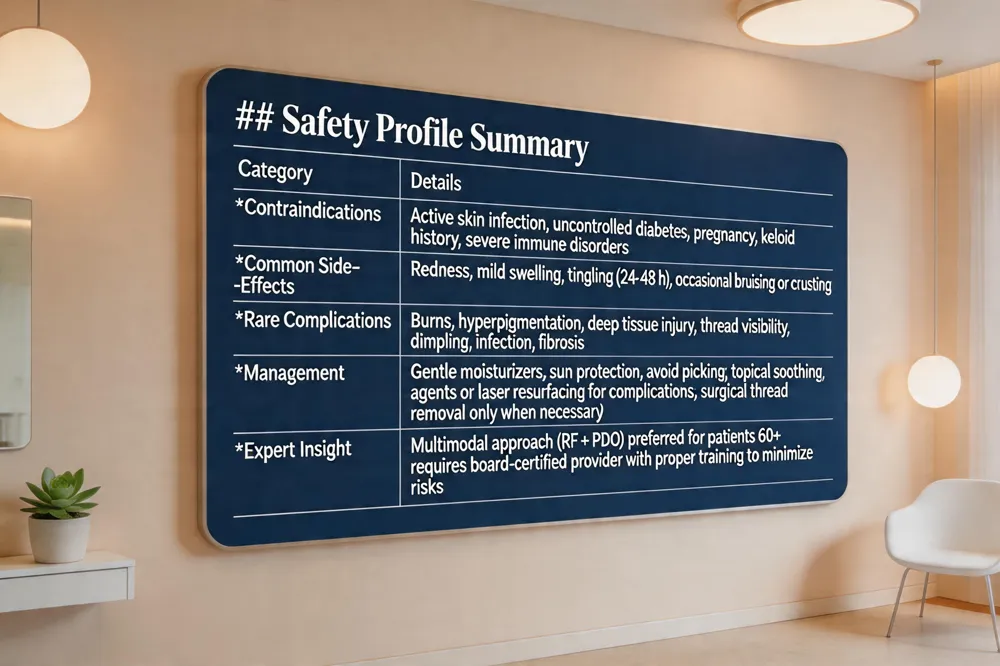 When combining PDO thread lifts with radiofrequency (RF) skin‑tightening, clinicians must first screen for contraindications such as active skin infections, uncontrolled diabetes, pregnancy, and a history of keloid scarring. Mild side effects—bruising, swelling, transient erythema—are common and usually resolve within a few days. More serious complications—burns, hyperpigmentation, or deep tissue injury—can occur if RF settings are excessive, the device is used on unsuitable skin types, or the practitioner lacks proper training. Prompt evaluation by a board‑certified aesthetic specialist is essential; treatment may involve soothing topicals, targeted laser resurfacing, or a modified RF protocol.
Some surgeons remain skeptical of PDO threads because the lift is temporary (6–12 months) and outcomes can vary with thread type, placement technique, and patient healing. Risks such as thread visibility, dimpling, infection, or fibrosis, though rare, contribute to this caution. The material does dissolve naturally; RF heat can accelerate absorption but is not a reliable removal method—surgical extraction under local anesthesia remains the most controlled option.
For mature patients (age 60+), a multimodal, non‑surgical approach is preferred. Deep‑tissue tightening with ultrasonic or RF microneedling, volume restoration with hyaluronic‑acid fillers, and neuromodulators such as Botox together address sagging, loss of volume, and dynamic wrinkles, delivering natural, longer‑lasting results when customized by an experienced dermatologist or plastic surgeon.
Putting It All Together: Protocol, Maintenance, and Patient Guidance
Step‑by‑Step Workflow & Maintenance
| Step | Action | Timing |
|---|---|---|
| 1️⃣ Consultation & Facial Analysis | Map lift vectors, select thread type | Day 0 |
| 2️⃣ Local Anesthesia | Topical or nerve block | Day 0 |
| 3️⃣ PDO Thread Insertion | Cog‑barbed + smooth threads placed sub‑dermally | Day 0 |
| 4️⃣ Immediate RF Treatment | Heat to 43‑47 °C (or 50‑75 °C for deeper devices) | Day 0 |
| 5️⃣ Post‑Procedure Care | Gentle cleansing, SPF, avoid strenuous facial movements | 48 h |
| 6️⃣ Follow‑up RF Microneedling | 1‑2 sessions, 4‑6 weeks apart | Month 1‑2 |
| 7️⃣ Evaluate Collagen Density | Touch‑up RF if plateau | Month 3‑6 |
| 8️⃣ Repeat RF / Optional Thread Refresh | If lift diminishes | Month 9‑12 |
| 9️⃣ Yearly Maintenance | 2‑3 RF sessions to sustain elasticity | Annually |
Patients are advised to schedule periodic touch‑ups every 2‑3 months during the first year to maximize durability.

Step‑by‑step combined treatment workflow
- Consultation & facial analysis – Board‑certified dermatologist or plastic surgeon maps key lift vectors (jawline, nasolabial folds, mid‑face) and selects thread type (cog‑barbed for lift, smooth for collagen).
- Local anesthesia – Topical or nerve‑block ensures comfort.
- PDO thread insertion – Threads are placed sub‑dermally along the predetermined vectors, providing an immediate mechanical lift and a scaffold for neocollagenesis.
- Immediate RF treatment – Using monopolar, bipolar or microneedle RF, the same zones are heated to 43‑47 °C (or 50‑75 °C for deeper devices). Heat contracts existing collagen and accelerates fibroblast activity around the threads.
- Post‑procedure care – Gentle cleansing, sun protection, and avoidance of strenuous facial movements for 48 hours.
Maintenance schedule for lasting lift
- Month 0: Thread placement + RF (single session).
- Month 1–2: Optional RF microneedling (1‑2 sessions, 4‑6 weeks apart) to boost collagen remodeling.
- Month 3–6: Evaluate collagen density; consider a touch‑up RF session if skin firmness plateaus.
- Month 9–12: Repeat RF (or combined thread‑RF) if lift begins to diminish; most patients maintain results 12‑24 months due to the autologous collagen matrix left after thread absorption.
- Yearly: Maintenance RF (2‑3 sessions) to sustain elasticity and delay repeat thread placement.
Frequently asked questions on effectiveness and alternatives
How to sculpt face without surgery? A sculpted look can be achieved with injectable fillers for volume, neuromodulators to relax dynamic muscles, PDO thread lifts for immediate lift, and energy‑based devices (RF or ultrasound) for skin tightening. Personalized plans combine these modalities for natural, incision‑free enhancement.
20‑minute permanent facelift? A 20‑minute “facelift” uses dissolvable PDO threads, ultrasound or laser energy to lift sagging skin and trigger collagen production. Results last 18‑24 months, not permanent; periodic touch‑ups are needed.
Is RF better than CoolSculpting? RF heats fat cells and tightens skin, while CoolSculpting freezes fat cells for removal. RF offers immediate skin‑tightening benefits; CoolSculpting’s tightening is milder and appears after fat loss. Choice depends on whether the goal is fat reduction alone or combined tightening.
Is RF really worth it? RF microneedling delivers controlled heat alongside microneedling, stimulating collagen and elastin for smoother texture and mild laxity improvement. Clinical studies show natural‑looking results over 3‑6 months with minimal downtime, making it a cost‑effective alternative to surgical facelifts for early‑stage sagging.
What is a Cinderella face lift? A minimally invasive, non‑surgical rejuvenation blending dissolvable PDO threads, Botox, dermal fillers, and optionally RF or microneedling. The procedure lasts about an hour, requires little anesthesia, and recovery is limited to a few days. Results are temporary (6 months–2 years) but provide a subtle, natural lift with minimal scarring.
Your Path to a Refined, Lifted Appearance
Combining absorbable poly‑dioxanone (PDO) threads with radiofrequency (RF) skin tightening delivers an immediate mechanical lift from the threads and a progressive collagen‑remodeling boost from RF heat, resulting in longer‑lasting firmness and smoother texture. At Iconic Laser we tailor each treatment plan to your facial anatomy, skin type, and aesthetic goals, using FDA‑cleared devices and board‑certified specialists. Experience a personalized, minimally invasive upgrade—schedule a confidential consultation today to discover how this synergistic approach can refresh your look and boost confidence today.