Why Transparency and Safety Matter in Aesthetic Medicine
Patients arrive with specific expectations about appearance, and meeting those expectations begins with honest, plain‑language discussions of risks, benefits, and alternatives. Informed consent is the legal and ethical foundation that guarantees patients understand the procedure, can ask questions, and voluntarily agree to treatment; documenting this conversation protects both parties. Clear communication—using visual aids, teach‑back methods, and digital consent tools—has been shown to lower anxiety, improve adherence to post‑procedure care, and reduce malpractice claims. Troy, Michigan clinics exemplify these principles by adhering to ASPS and Joint Commission safety standards, employing board‑certified providers, using standardized checklists, and integrating electronic health‑record consent portals to ensure every step is transparent and auditable.
Fundamentals of Informed Consent
| Element | Description |
|---|---|
| 8 Elements of Informed Consent | 1. Purpose, duration, procedures; 2. Risks; 3. Benefits; 4. Alternatives; 5. Confidentiality; 6. Compensation for research injury; 7. Contact info; 8. Voluntary participation |
| 4 Principles | 1. Decision‑making capacity; 2. Full disclosure; 3. Patient comprehension; 4. Voluntary agreement |
| 5 Essential Elements | Full disclosure; comprehension (plain language/visual aids); voluntariness; capacity; expressed consent (written/e‑) |
| Types of Consent | Implied, Verbal (express), Written |
 Transparent communication is the cornerstone of patient safety in aesthetic medicine. It ensures that patients understand what will be done, why, and what to expect.
What are the 8 elements of informed consent?
- Statement of the activity’s purpose, duration, and procedures. 2. Description of foreseeable risks or discomforts. 3. Potential benefits to the patient or others. 4. Disclosure of alternative treatments. 5. Assurance of confidentiality. 6. Information on compensation and medical treatment for research‑related injury when risk is more than minimal. 7. Contact details for questions and reporting injury. 8. Declaration of voluntary participation with no penalty for refusal or withdrawal.
What are the 4 principles of informed consent?
- Decision‑making capacity. 2. Full disclosure of diagnosis, procedure, risks, benefits, and alternatives. 3. Patient comprehension. 4. Voluntary agreement without coercion.
What are the 5 essential elements?
Full disclosure, patient comprehension (using plain language and visual aids), voluntariness, decision‑making capacity, and expressed informed consent (written or electronic).
Three types of informed consent in healthcare
- Implied consent (inferred from patient actions).
- Verbal (express) consent after a spoken explanation.
- Written consent, the signed document, used for most aesthetic procedures.
Patient Safety Protocols at Our Troy Clinic
| Protocol | Details |
|---|---|
| Infection Control | CDC/OSHA compliance, mandatory masks, temperature screening, 30‑sec hand‑wash for each visitor |
| PPE & Room Disinfection | Enhanced PPE for staff, disinfect treatment rooms after each patient, daily deep‑clean of facility |
| Staff Screening | Morning health screen, 14‑day COVID‑19 quarantine for exposure |
| Patient Flow | Wait in vehicle or treatment room, no shared waiting area |
| X‑ray Capability | On‑site imaging to avoid delays |
| Photographic Documentation | Private capture, secure EMR storage, used only for planning/outcome |
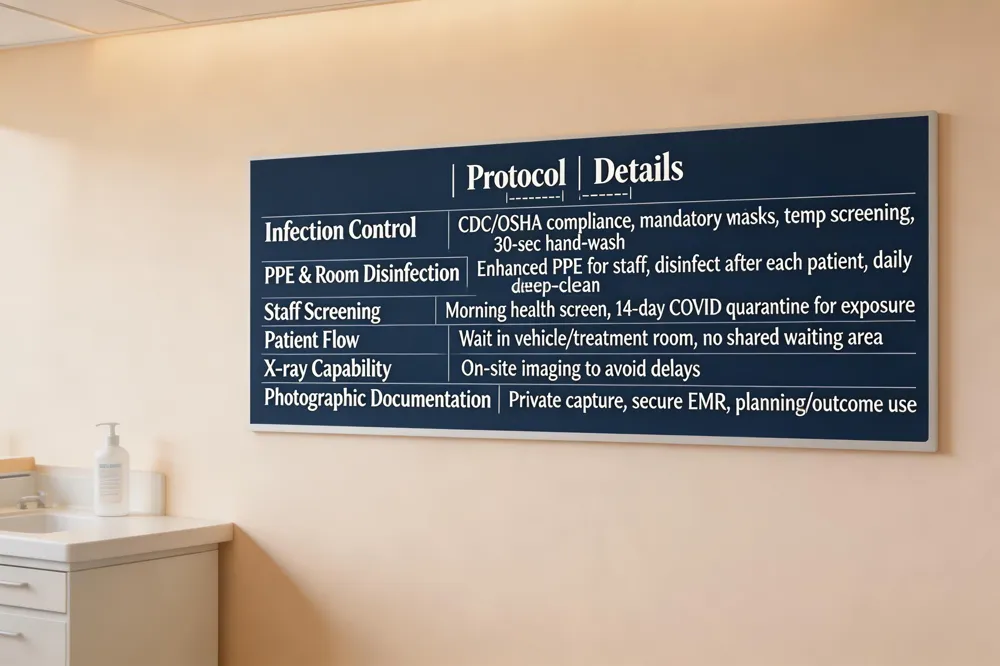 Patient safety is our highest priority at our Troy, Michigan aesthetic clinic. We adhere to CDC and OSHA infection control requirements, adding extra safeguards such as mandatory masks, temperature screenings, and a 30‑second hand‑wash protocol for every visitor. Staff members wear enhanced personal protective equipment and disinfect treatment rooms after each patient; a comprehensive deep‑clean of the entire facility is performed daily. All staff are screened each morning, and anyone exposed to COVID‑19 within the past 14 days must self‑quarantine before returning to work. To limit exposure, patients wait in their vehicles or treatment rooms rather than a shared waiting area, and we encourage any safety‑related concerns to be communicated immediately.
Patient reviews consistently highlight our focus on safety. Reviewers praise clinicians for listening, conducting thorough examinations, and providing accurate diagnoses, often resolving issues on the spot. The on‑site X‑ray capability eliminates delays, reducing the risk of missed findings. Staff are described as patient, attentive, and diligent about maintaining a clean, organized environment, reinforcing confidence in our safety culture.
Photographic documentation is handled with strict confidentiality. Images are captured in a private setting, stored securely in the patient’s electronic medical record, and used only for treatment planning and outcome tracking. This transparent yet secure approach ensures that every aesthetic procedure is performed safely, effectively, and with full respect for patient privacy.
Transparency in Communication and Documentation
| Aspect | Key Points |
|---|---|
| Importance | Builds trust, sets realistic expectations, reduces anxiety and litigation |
| Plain‑Language | 6th‑grade reading level, avoid jargon, ASPS/AAD guidelines |
| Visual Aids & Teach‑Back | Before‑and‑after photos, diagrams, 3‑D sims, confirm understanding |
| Digital Consent Tools | Interactive e‑signatures, video modules, patient portal, audit trail |
| Data Transparency Pros | Patient empowerment, reduced redundant testing, quality improvement |
| Data Transparency Cons | Privacy breach risk, data overload, need for HIPAA security |
 Why is transparency in healthcare important? Transparent communication builds trust by giving patients clear insight into treatment options, risks, benefits, and costs. In aesthetic medicine, this empowers individuals to set realistic expectations, reduces anxiety, and lowers the likelihood of postoperative dissatisfaction or litigation. When providers openly share safety data and pricing, patients can compare options and make informed choices, leading to higher satisfaction and better outcomes.
Plain‑language explanations – Consent forms and verbal brief should be written at a 6th‑grade reading level, using everyday terms and avoiding jargon. This aligns with ASPS and AAD guidelines and improves comprehension across diverse literacy levels.
Visual aids and teach‑back – Before‑and‑after photos, diagrams, and 3‑D simulations help patients visualize results. The teach‑back method confirms understanding, a strategy shown to boost recall of risks and post‑care instructions.
Digital consent tools – Interactive e‑signatures, video modules, and patient portals provide audit trails, enhance engagement, and allow real‑time updates to consent status.
Pros and cons of data transparency – Benefits include patient empowerment, reduced redundant testing, and quality‑improvement insights. Risks involve privacy breaches, potential data overload, and the need for robust security safeguards per HIPAA.
Informed consent practices in clinical research: present and future – Current practice emphasizes voluntariness, comprehensive disclosure, and ongoing consent. Emerging innovations—multimedia presentations, adaptive electronic platforms, and real‑time capacity assessments—promise greater clarity and personalized education while maintaining ethical standards.
Informed consent example – "You are invited to a skin‑rejuvenation treatment using laser or injectable modalities. Risks include temporary redness, swelling, bruising, and rare allergic reactions. Benefits may include smoother, more radiant skin. Your information will remain confidential, and you may withdraw consent at any time without penalty."
Informed consent PDF – Our clinic provides a downloadable PDF outlining procedure steps, risks, benefits, and privacy protections. Signing the form confirms patient understanding and agreement to safety protocols. The PDF is available on our website or at the front desk.(Informed consent PDF)
Procedural Consent Forms and Legal Requirements
| Procedure | Core Consent Elements |
|---|---|
| Subcision | Anesthesia description, risks (pain, bruising, scarring, infection), after‑care commitment |
| Laser | Specific laser, benefits, alternatives, risks (redness, pigment change, burns, infection), photo release |
| Radiofrequency | Treatment area, RF mechanism, side effects (swelling, burns, infection), contraindications |
| Botox | Demographics, botulinum toxin info, duration, risks (bruising, eyelid droop), alternatives, payment |
| Chemical Peel | Steps, benefits, risks (redness, peeling, pigment change, herpes), pregnancy/medication disclosure |
| Cautery | Electrosurgical removal, risks (pain, scarring, hyper‑pigmentation), alternatives, liability release |
| Skin Biopsy | Tissue removal purpose, risks (pain, bleeding, scarring), anesthesia, follow‑up |
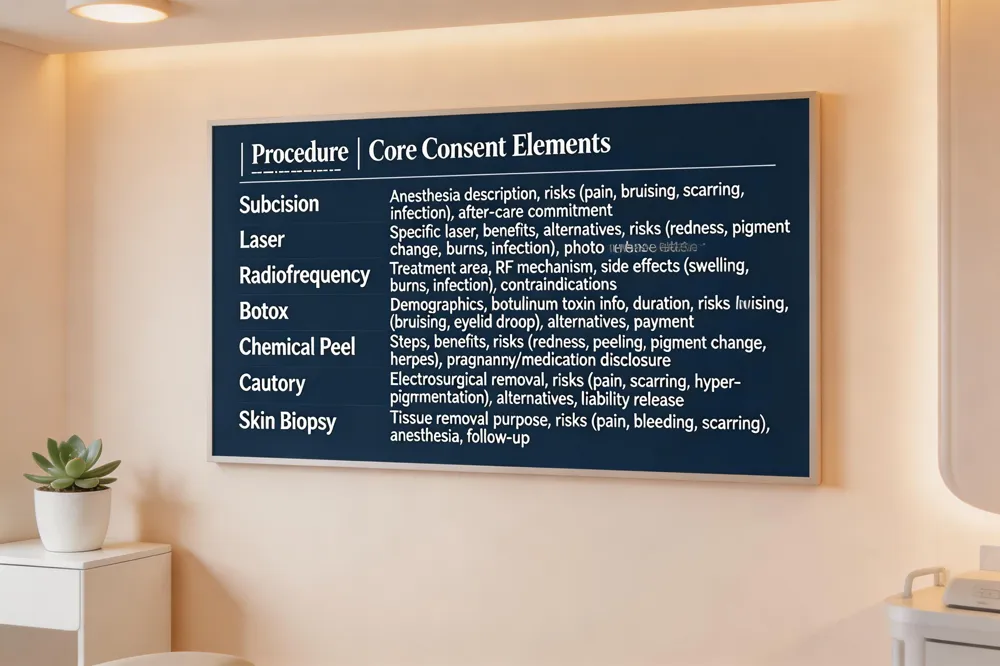 Subcision consent form
A Subcision consent form is a written agreement signed before the subcutaneous needle‑release procedure for depressed acne scars or cellulite. It explains topical anesthesia or lidocaine use, outlines risks such as pain, bruising, swelling, scarring, infection, and the possibility of incomplete results, and confirms the patient’s understanding and commitment to after‑care.
Subcision consent form
A Subcision consent form is a written agreement signed before the subcutaneous needle‑release procedure for depressed acne scars or cellulite. It explains topical anesthesia or lidocaine use, outlines risks such as pain, bruising, swelling, scarring, infection, and the possibility of incomplete results, and confirms the patient’s understanding and commitment to after‑care.
Laser consent form The laser consent form details the specific laser or light‑based treatment, expected benefits, alternatives, and risks—including temporary redness, pigment changes, rare burns, scarring, infection, or herpes reactivation. It records the patient’s acknowledgment of pre‑ and post‑procedure instructions and authorizes use of before‑and‑after photos.
Radiofrequency (RF) consent form The RF consent form identifies the treatment area, describes how RF energy heats dermal tissue to stimulate collagen, and lists side effects such as swelling, minor burns, blisters, and rare infection. Patients confirm no contraindications (e.g., pacemakers, pregnancy) and agree to after‑care and photographic documentation.
Botox consent form This form records patient demographics, explains botulinum toxin use, expected duration, and common risks (bruising, temporary eyelid droop, rare allergic reaction). It requires acknowledgment of contraindications, alternative options, payment responsibility, and the right to discontinue treatment.
Chemical peel consent form The chemical peel consent outlines procedure steps, benefits, and risks like redness, peeling, pigment changes, infection, and herpes reactivation. Patients disclose pregnancy, medications, and skin disorders, and agree to sunscreen use and post‑peel care.
Cautery consent form A cautery consent explains electrosurgical lesion removal, risks (pain, scarring, hyper‑pigmentation, infection), alternatives, and post‑procedure care. Signing authorizes the physician to perform the procedure and releases liability.
Skin biopsy consent form The skin‑biopsy consent describes tissue removal for pathology, risks (pain, bleeding, scarring, pigment changes), anesthesia use, and possible additional treatment. Patients confirm understanding and agree to follow‑up instructions.
Do you need informed consent for a skin biopsy? Yes. Patients must be fully informed about purpose, procedure, risks, benefits, and alternatives before a skin biopsy.
Michigan licensing rules, HIPAA, and electronic signatures All providers in Troy, MI must hold a valid Michigan medical license and, for many aesthetic procedures, board certification in dermatology or plastic surgery. Consent forms must be stored in a HIPAA‑compliant EHR, ensuring confidentiality of protected health information. Electronic signatures and interactive digital consent tools are acceptable when they meet ESIGN Act standards, provide audit trails, and allow patients to review consent material at their own pace.
Choosing Qualified Providers and Understanding Scope of Practice
| Criterion | Details |
|---|---|
| Board Certification | ABPS or ABCS, ASPS/AAD membership, evidence‑based practice |
| Training Pathway | MD/DO → USMLE/COMLEX → 6‑yr integrated plastic surgery residency or 3‑yr fellowship, board exams |
| Scope in Michigan | Clinics: licensed physicians/nurses can inject; Salons/Estheticians: limited to non‑invasive cosmetics, no Botox/fillers without supervision |
| Selecting Surgeon | Verify certification, review comparable before‑after photos, confirm procedural experience, ASPS safety checklist compliance |
| Regulatory Compliance | Michigan medical license, HIPAA‑compliant EHR, ESIGN‑act electronic signatures |
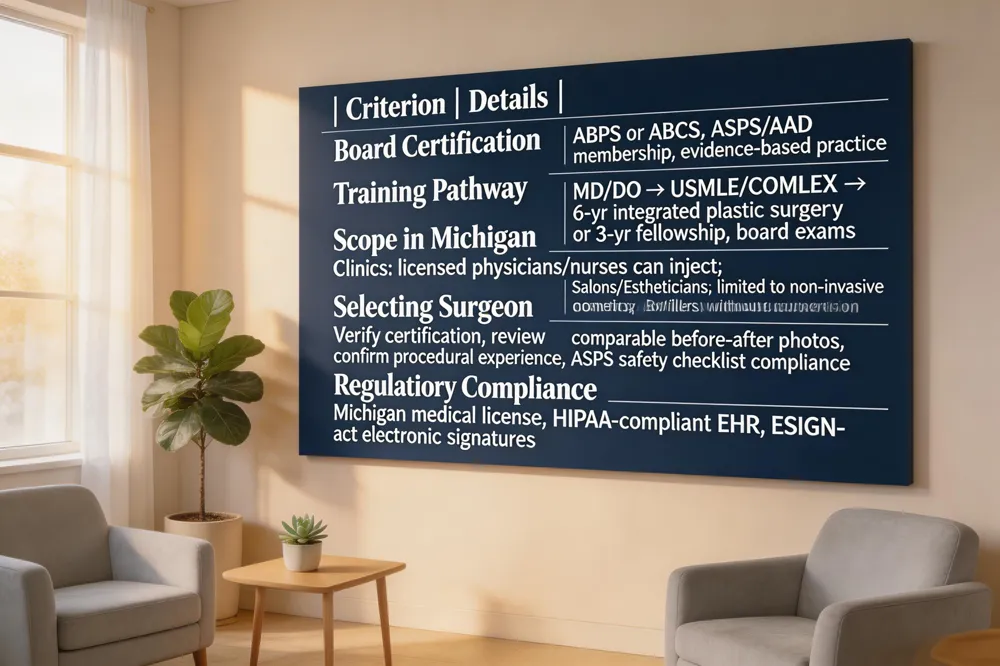 Board Certification & Professional Societies
In the United States, board certification by the American Board of Plastic Surgery (ABPS) or the American Board of Cosmetic Surgery (ABCS) signals that a surgeon has completed rigorous residency training, passed comprehensive examinations, and commits to ongoing education. Membership in societies such as the American Society of Plastic Surgeons (ASPS) or the American Academy of Cosmetic Surgery further assures adherence to safety standards and evidence‑based techniques.
Board Certification & Professional Societies
In the United States, board certification by the American Board of Plastic Surgery (ABPS) or the American Board of Cosmetic Surgery (ABCS) signals that a surgeon has completed rigorous residency training, passed comprehensive examinations, and commits to ongoing education. Membership in societies such as the American Society of Plastic Surgeons (ASPS) or the American Academy of Cosmetic Surgery further assures adherence to safety standards and evidence‑based techniques.
Pathway to Becoming a Reconstructive Plastic Surgeon After earning an MD or DO and passing USMLE/COMLEX, a physician enters a six‑year integrated plastic‑surgery residency or a three‑year independent pathway following general‑surgery training. Completion of ACGME case‑log requirements, state licensure, and passing ABPS written and oral exams culminate in board certification. Many surgeons pursue fellowships in hand, craniofacial, or microsurgery to refine reconstructive expertise.
Clinic vs. Salon & Esthetician Scope in Michigan An aesthetic clinic is a medical facility staffed by licensed physicians, nurses, or certified practitioners who can prescribe and administer injectable drugs, lasers, and other regulated treatments. A beauty salon offers cosmetology services only; Michigan law restricts Botox, dermal fillers, and similar procedures to licensed medical professionals. Estheticians may assist but cannot inject Botox without physician supervision.
Selecting a Good Plastic Surgeon Verify board certification, review before‑and‑after photos of patients with similar anatomy, inquire about procedure‑specific experience, and confirm that the practice follows ASPS safety checklists, accreditation, and HIPAA‑compliant documentation.
Cosmetic Safety & Minor/Simple Procedures Cosmetic safety encompasses FDA‑approved devices, sterile technique, and transparent risk disclosure. Minor surgeries (e.g., chin implants, upper‑lip lifts) and simple, minimally invasive treatments (Botox, fillers, chemical peels) are performed in office settings with local anesthesia, offering natural results and short recovery while maintaining rigorous safety protocols.
Putting Transparency and Safety Into Practice
Our clinic follows the four safety pillars—procedure appropriateness, patient suitability, qualified surgeon, and accredited setting—while embedding transparent informed‑consent practices. Every patient receives a plain‑language consent form, visual aids, and a teach‑back discussion that confirms understanding of risks, benefits, alternatives, and post‑care instructions. This empowers individuals to ask questions, weigh options, and make truly informed decisions aligned with personal goals. By sharing realistic outcome expectations and documenting the conversation, we reduce anxiety, enhance satisfaction, and lower adverse‑event rates. Ready to experience safe, personalized aesthetic care? Schedule a consultation today and take the first step toward confident, science‑backed results with a dedicated team.