Why Personalization Matters in Modern Aesthetic Medicine
The era of one‑size‑fits‑all skincare is ending as patients demand results that reflect their unique biology and lifestyle. Data‑driven platforms now combine high‑resolution 3‑D imaging, AI‑powered facial analysis, and DNA or microbiome testing to pinpoint precise concerns—whether it is early photo‑aging, acne, or rosacea. This granular information lets clinicians formulate custom‑compounded actives, adjust laser fluence, or select filler volumes that match each individual’s collagen density, pigment pattern, and vascular architecture. Clinician‑guided programs go beyond isolated procedures, integrating nutrition, stress management, and sleep hygiene to support holistic skin health. The result is faster, more visible improvements, lower risk of adverse reactions, and sustained long‑term outcomes—all while preserving the natural look patients seek. In short, personalized, science‑backed care transforms aesthetic medicine from a reactive service into a proactive, individualized wellness regimen.
Age‑Defying Microneedling: Safe for Seniors
Age‑Defining Microneedling – Quick Reference
| Aspect | Details |
|---|---|
| Target Population | Adults 60+ (slower collagen production & healing) |
| Adjustable Parameters | Needle depth, speed, density to match skin resilience |
| Pre‑procedure Screening | Review medications, chronic illnesses, skin disorders |
| Post‑care Recommendations | Gentle cleansing, barrier‑repair moisturizers, strict SPF |
| Primary Benefits | Enhanced texture, tone, fine‑line reduction with minimal downtime |
| Safety Note | Age alone is not a barrier when protocol is personalized |
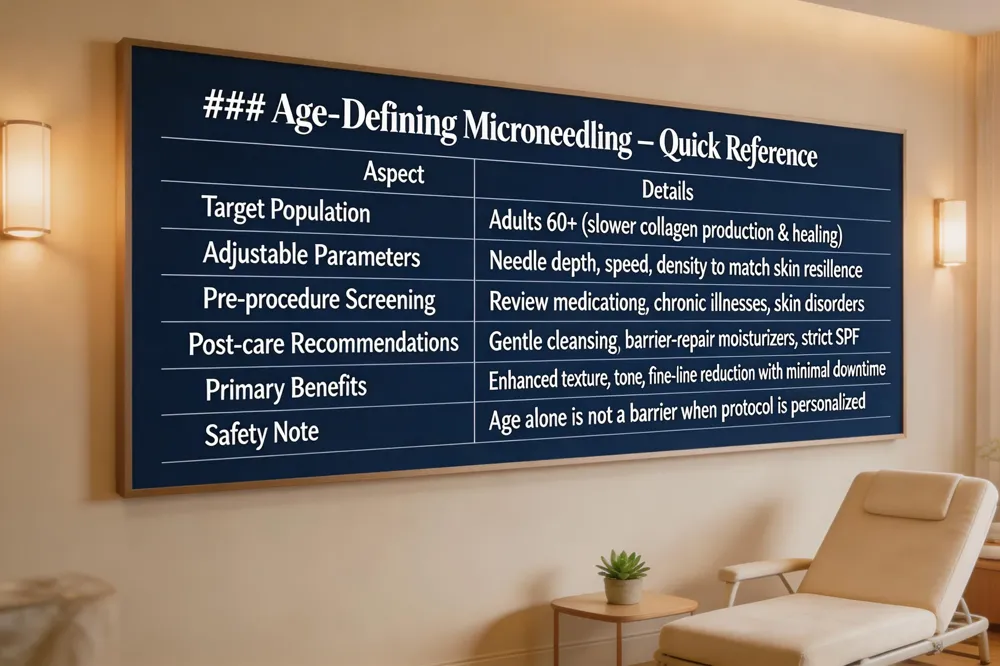 Microneedling stimulates collagen‑induction by creating controlled micro‑injuries that trigger the skin’s natural repair cascade, even in mature skin where collagen production naturally declines. Modern devices allow clinicians to adjust needle depth, speed, and density, tailoring the treatment to the slower healing capacity of patients in their 60s and beyond. Before any procedure, a thorough health screening—reviewing medications, chronic conditions, and skin disorders—ensures safety and helps set realistic expectations. Post‑care recommendations include gentle cleansing, barrier‑repair moisturizers, and strict sun protection to support optimal regeneration.
Is 60 too old for microneedling?
Microneedling is generally safe and effective for people in their 60s. While skin after 60 produces less collagen and heals more slowly, the adjustable parameters of contemporary devices accommodate these changes, delivering noticeable improvements in texture, tone, and fine lines with minimal downtime. A personalized consultation is essential to evaluate health concerns and tailor the protocol, but age alone is not a barrier to benefiting from this minimally invasive, science‑backed rejuvenation technique.
2026 Aesthetic Trends: Natural, Regenerative, and Custom
2026 Aesthetic Trends – Overview
| Trend | Description |
|---|---|
| Ultra‑natural, undetectable outcomes | Micro‑dose neuromodulators, low‑downtime laser resurfacing, refined injectables preserving facial dynamics |
| Facial fat transfer & autologous volume | Fat grafting enriched with PRP for lasting, biologically active restoration |
| Platelet‑rich fibrin (PRF) | Autologous scaffold delivering growth factors over weeks to boost collagen after procedures |
| Designer facelifts | Hybrid surgery + precision injectables for personalized rejuvenation |
| Neuromodulators & energy‑based lasers | Continued use of Botox®, Dysport®, IPL, fractional CO₂, RF for wrinkle prevention & texture improvement |
| Regenerative focus | Emphasis on skin health, collagen synthesis, and minimal invasiveness |
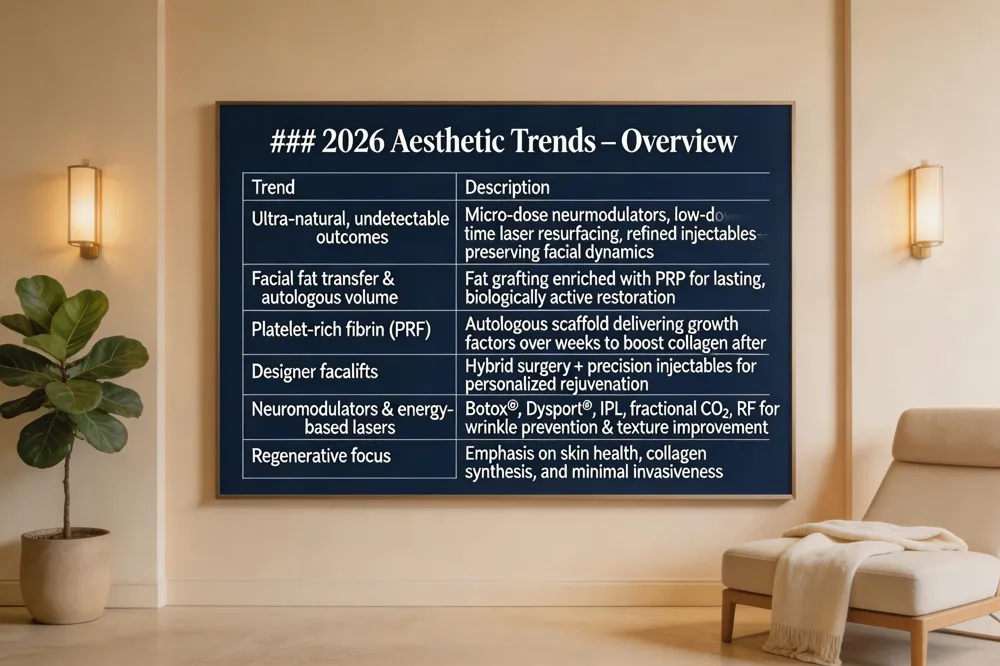 In 2026 the aesthetic landscape will be defined by ultra‑natural, undetectable outcomes that enhance each patient’s innate features rather than impose a one‑size‑fits‑all look.
Ultra‑natural, undetectable outcomes – Patients will prioritize subtle, "skin‑imal" results achieved through micro‑dose neuromodulators, low‑downtime laser resurfacing, and refined injectable techniques that preserve facial dynamics.
Facial fat transfer and autologous volume restoration – Autologous fat grafting, often enriched with stem‑cell‑rich PRP, will dominate volume restoration, delivering long‑lasting, biologically active tissue that improves both contour and skin quality without foreign fillers.
Platelet‑rich fibrin (PRF) as a growth‑factor delivery platform – PRF will surge as a safe, autologous scaffold that releases growth factors over weeks, boosting collagen synthesis and healing after microneedling, laser, or surgical procedures.
Designer facelifts blending surgery and injectables – Hybrid facelifts will combine minimal‑invasive surgical lifts with precision‑placed volumizing fillers and neuromodulators, creating personalized rejuvenation plans that address individual anatomy and aging patterns.
Continued importance of neuromodulators and energy‑based lasers – BOTOX®, Dysport, and newer long‑lasting neuromodulators will remain essential for wrinkle prevention, while advanced IPL, fractional CO₂, and RF lasers will be used to refine texture, tone, and radiance with minimal downtime.
Answer to question: The most popular aesthetics in 2026 will focus on ultra‑natural, undetectable results, facial fat transfer for balanced volume, PRF for growth‑factor delivery, designer facelifts that merge surgery with injectables, and the ongoing use of neuromodulators and energy‑based lasers to achieve personalized, regenerative skin health.
Cutting‑Edge Skin Rejuvenation in 2025
2025 Skin Rejuvenation Innovations
| Innovation | Benefits |
|---|---|
| Biostimulatory fillers (Sculptra, Radiesse) | Volume restoration + new collagen growth for gradual lift |
| Regenerative therapies (PRF, stem‑cell microinjections, exosome serums) | Enhanced tissue repair, elasticity, and barrier function |
| Integrated laser‑RF platforms with AI | Tailored energy delivery based on texture, hydration, pigment profile |
| Collagen banking & peptide‑infused protocols | Extended longevity of results and deeper actives penetration |
| High‑concentration actives (azelaic acid, niacinamide, tretinoin) + exosome delivery | Deeper penetration without compromising barrier, synergistic rejuvenation |
| Advanced imaging (3‑D mapping, AI analysis) | Precise, individualized treatment planning |
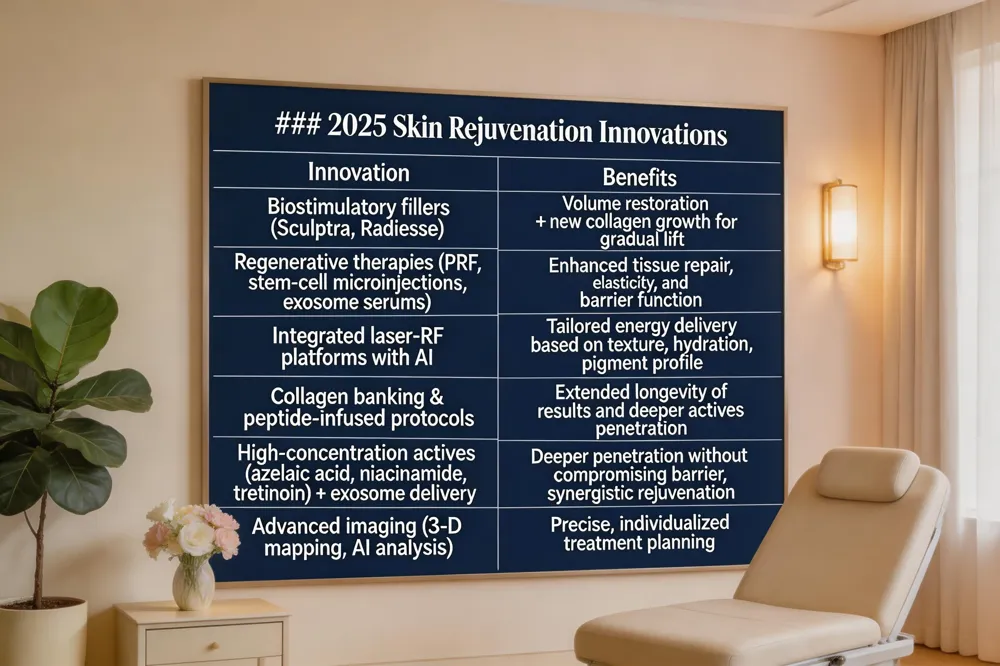 In 2025, skin rejuvenation blends biologic and tech‑driven approaches for faster, longer‑lasting results. Biostimulatory fillers such as Sculptra and Radiesse not only restore volume but also stimulate new collagen growth, delivering a gradual, natural lift. Regenerative therapies—including platelet‑rich fibrin (PRF), stem‑cell microinjections, and exosome‑rich serums—enhance tissue repair and elasticity from within. Integrated laser‑radiofrequency platforms combined with AI‑guided personalized treatment plans tailor energy delivery and product selection to each patient’s texture, hydration and pigment profile. Emerging “collagen banking” and peptide‑infused protocols further extend outcomes, making skin renewal safer, more efficient, and more durable. These innovations are currently being deployed in premium U.S. clinics such as those in Troy, Michigan, where board‑certified dermatologists use advanced imaging, 3‑D skin mapping, and AI‑driven analysis to create individualized protocols. By combining high‑concentration actives—azelaic acid, niacinamide, tretinoin—with cutting‑edge delivery systems like exosomes, clinicians achieve deeper penetration without compromising the skin barrier. The result is a holistic, science‑backed rejuvenation plan that addresses multiple concerns, reduces downtime, and supports long‑term skin health.
The Ten‑Year Turnback: Combined Minimally Invasive Protocols
Ten‑Year Turnback Protocol – Core Components
| Treatment | Role |
|---|---|
| Botox/Dysport (neurotoxin) | Relax dynamic wrinkles (forehead, glabellar, crow’s feet) for smoother canvas |
| Medical‑grade chemical peels | Resurface skin, improve tone, brighten pigment, increase cell turnover |
| Soft‑tissue fillers (hyaluronic‑acid, Sculptra) | Restore lost volume in cheeks, lips, nasolabial folds, provide structural lift |
| Sequencing & monitoring | Neurotoxin → peel → filler; AI‑driven scans & telehealth check‑ins for safety and efficacy |
| Personalized assessment | Baseline skin analysis (genetics, microbiome) to tailor concentrations & timing |
| Outcome | Removal of ~10 years of visible aging with natural appearance and minimal downtime |
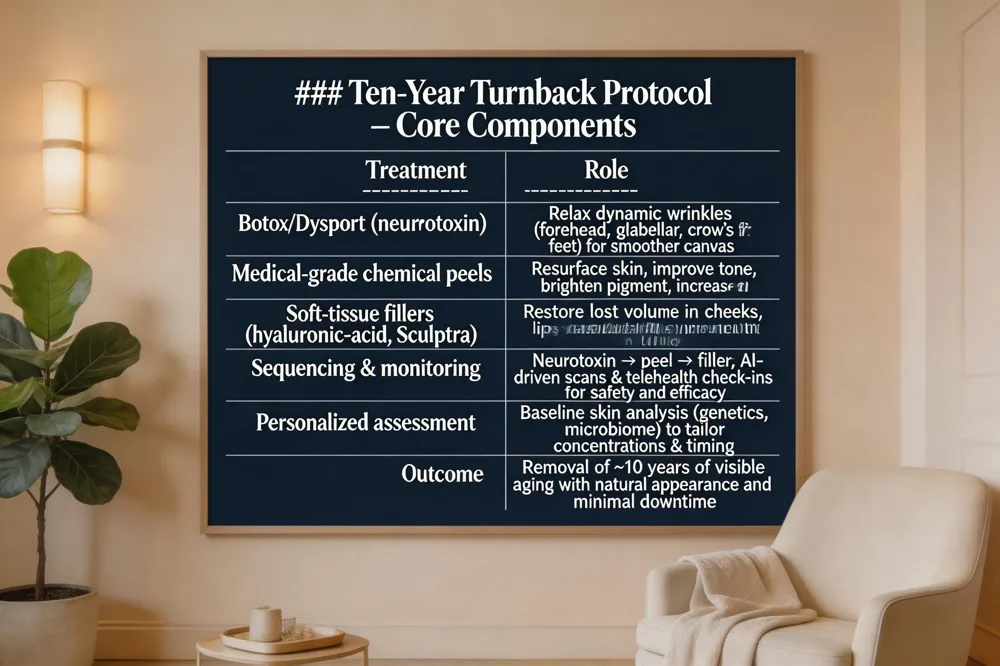 Modern aesthetic medicine offers a science‑backed, minimally invasive roadmap for erasing a decade of facial aging.
Botox/Dysport for dynamic wrinkle relaxation – Neurotoxin injections target the muscles that create expression lines. By relaxing the forehead, glabellar and crow’s‑feet muscles, both Botox® and Dysport® soften dynamic wrinkles, delivering a smoother, younger‑looking canvas with virtually no downtime.
Medical‑grade chemical peels for resurfacing and tone improvement – Higher‑concentration, clinician‑prescribed peels (e.g., glycolic, trichloroacetic, or salicylic blends) penetrate deeper than over‑the‑counter formulas, removing damaged keratinocytes, brightening uneven pigment, and diminishing fine lines. When performed under physician guidance, these peels enhance skin texture while preserving barrier integrity.
Soft‑tissue fillers for volume restoration – Hyaluronic‑acid or collagen‑stimulating fillers such as Juvederm®, Belotero® and Sculptra® rebuild lost volume in the cheeks, lips, and nasolabial folds. Precision injection techniques, often guided by 3‑D imaging or AI‑driven mapping, ensure natural contouring and long‑lasting support.
Synergistic treatment sequencing and patient monitoring – A personalized protocol begins with a comprehensive skin assessment (including AI‑driven scans and genetic or microbiome insights). Treatments are staggered—neurotoxin first to relax muscles, followed by a chemical peel to improve surface quality, and concluding with filler placement for structural lift. Ongoing telehealth check‑ins and periodic re‑scans allow clinicians to adjust concentrations, address side‑effects, and fine‑tune results, ensuring optimal safety and efficacy.
Answer: What takes 10 years off your face? A coordinated, minimally invasive regimen that couples targeted Botox/Dysport, medical‑grade chemical peels, and soft‑tissue fillers—delivered under expert physician supervision and continuously monitored—can effectively remove a decade of visible aging while preserving a natural appearance and requiring minimal recovery time.
Morpheus8 and Advanced Dermatology Procedures in Troy
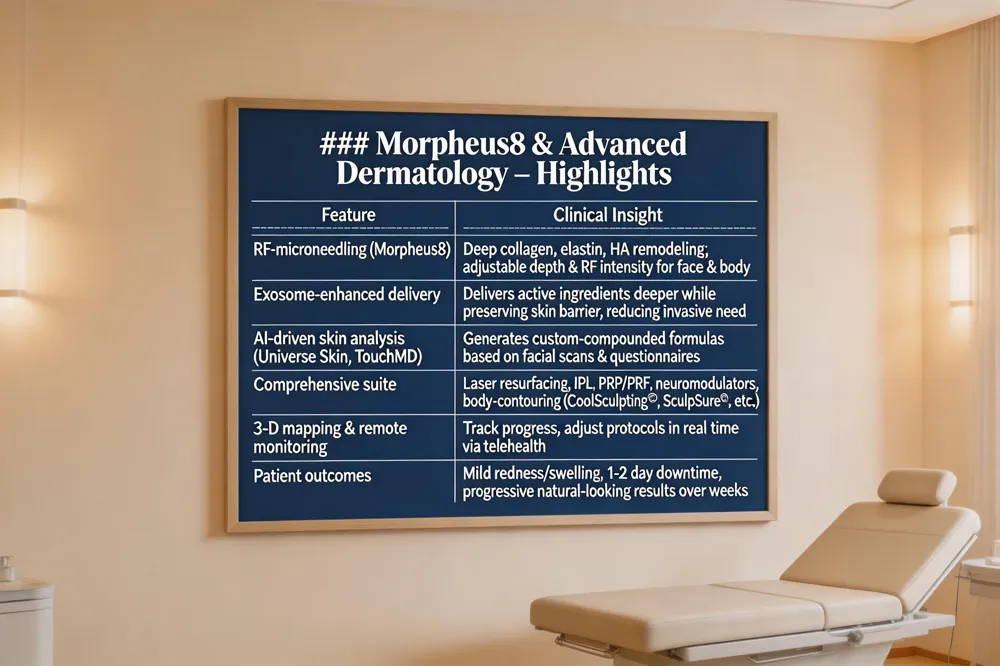
Morpheus8 & Advanced Dermatology – Highlights
| Feature | Clinical Insight |
|---|---|
| RF‑microneedling (Morpheus8) | Deep collagen, elastin, HA remodeling; adjustable depth & RF intensity for face & body |
| Exosome‑enhanced delivery | Vehicles active ingredients deeper while preserving skin barrier, reducing need for invasive need |
| AI‑driven skin analysis (Universe Skin, TouchMD) | Generates custom‑compounded formulas based on facial scans & questionnaires |
| Comprehensive suite | Laser resurfacing, IPL, PRP/PRF, neuromodulators, body‑contouring (CoolSculpting®, SculpSure®, etc.) |
| 3‑D mapping & remote monitoring | Track progress, adjust protocols in real time via telehealth |
| Patient outcomes | Mild redness/swelling, 1‑2 day downtime, progressive natural‑looking results over weeks |
 Morpheus8 – RF‑microneedling for deep collagen remodeling
Morpheus8, a minimally invasive FDA‑approved treatment, fuses fractional radiofrequency with microneedling to stimulate deep collagen, elastin, and hyaluronic‑acid production. Adjustable needle depth and RF intensity let clinicians tailor the procedure for delicate under‑eye areas or larger zones such as the neck, jawline, arms, and abdomen. Patients experience only mild redness and swelling, resume normal activities within 1‑2 days, and see progressive, natural‑looking results over several weeks. The technology is safe for all skin types, including darker tones, making it a versatile option for facial rejuvenation and body contouring without surgery.
Exosome‑enhanced delivery systems
Exosome technology is being incorporated to ferry active ingredients deeper into the skin while preserving the barrier, reducing reliance on invasive microneedling. This next‑gen delivery boosts the efficacy of medical‑grade actives such as azelaic acid, niacinamide, and tretinoin.
AI‑driven skin analysis platforms
Platforms like Universe Skin and TouchMD analyze facial scans and questionnaires to generate custom‑compounded formulas unique to each patient, enabling hyper‑personalized regimens.
Comprehensive suite of treatments
Our Troy clinic offers laser resurfacing, IPL, PRP/PRF, injectable neuromodulators, and body‑contouring technologies (CoolSculpting®, SculpSure®, etc.)—all integrated into a cohesive, personalized plan.
Personalized pathways and remote monitoring
Clinicians use 3‑D mapping and telehealth to track progress, adjust protocols in real time, and ensure optimal, long‑term skin health.
Morpheus treatment
Morpheus treatment, commonly known as Morpheus8, is a minimally invasive, FDA‑approved procedure that fuses fractional radiofrequency (RF) energy with microneedling to stimulate deep collagen, elastin, and hyaluronic‑acid production. By delivering controlled heat into the dermis and subdermal layers, it tightens lax skin, smooths fine lines and wrinkles, and improves texture, acne scars, and hyperpigmentation with only mild redness and swelling afterward. The system’s adjustable needle depth and RF intensity allow clinicians to tailor the treatment for delicate areas such as under the eyes or broader zones like the neck, jawline, arms, and abdomen. Patients typically experience minimal downtime and can resume normal activities within a day or two, while seeing progressive, natural‑looking results over several weeks. Morpheus8 is suitable for all skin types, including darker tones, making it a versatile option for facial rejuvenation and body contouring without surgery.
Advanced dermatology procedures
Our Troy, Michigan clinic delivers a full spectrum of advanced dermatology procedures, from non‑invasive laser skin resurfacing and IPL photofacials to medical‑grade chemical peels such as the VI Peel. We specialize in cutting‑edge microneedling (Morpheus8) and PRP/PRF therapies that stimulate collagen and promote tissue regeneration, as well as exosome‑based treatments for rapid skin rejuvenation. Cosmetic injectables—including Botox, Dysport, Juvéderm®, Restylane® and Radiesse—are expertly administered to smooth wrinkles, restore volume, and enhance facial contours. For body sculpting and tightening, we offer CoolSculpting®, SculpSure, PHYSIQ, Venus Bliss, VelaShape and Kybella® to target stubborn fat and improve skin elasticity with minimal downtime. Each treatment is tailored to a personalized facial rejuvenation plan, ensuring optimal results and a smooth, radiant complexion.
Looking Ahead: Personalized Care as the New Standard
The next generation of medical aesthetics will fuse AI‑driven skin analysis, exosome‑enhanced delivery and and genetic or microbiome testing to craft truly bespoke regimens. AI platforms such as Universe Skin and Dermat Skin can map facial texture, predict pigment shifts, and recommend custom‑compounded actives, while exosome carriers ferry potent ingredients past the barrier for deep, non‑invasive rejuvenation. Clinicians will also embed holistic wellness—targeted nutrition, optimized sleep, and stress‑reduction protocols—into treatment plans, recognizing that lifestyle factors modulate skin biology as much as topicals or lasers. Continuous patient education and remote monitoring via tele‑dermatology portals will enable real‑time adjustments, ensuring adherence and long‑term health. Looking forward, 3‑D‑printed skin scaffolds, stem‑cell‑derived exosome therapies, and inclusive AI calibrated for all skin tones promise to expand the toolkit, making precision, regenerative, and equitable care the new norm.