Why Screening Matters in Aesthetic Medicine
Thorough patient screening is the cornerstone of safe aesthetic practice. By reviewing medical history, allergies, anticoagulant use, and recent infections, clinicians prevent blood‑borne pathogen transmission and minimize bruising, swelling, and vascular complications—key concerns highlighted by CDC and WHO injection‑safety guidelines. Regulatory bodies such as the FDA, ASDS, and state medical boards require documented screening, verification of FDA‑approved products, and adherence to single‑use needle policies, ensuring compliance with standards like USP <797> and the CDC’s One & Only Campaign. Proper screening also improves outcomes: identifying contraindications (e.g., pregnancy, active skin disease) and using individualized risk assessments reduces adverse events, enhances patient satisfaction, and supports consistent, evidence‑based aesthetic results.
Pre‑Procedure Medical Review and Medication Management
 A thorough medical history is the foundation of safe aesthetic injections. Clinicians must document allergies, current medications (especially anticoagulants, NSAIDs, and herbal supplements), recent illnesses, and prior cosmetic procedures. Blood‑thinners such as aspirin, ibuprofen, fish oil, vitamin E, garlic, and ginkgo biloba should be stopped at least one week before treatment to reduce bruising risk. Likewise, topical irritants—including retinol, tretinoin, AHAs, and BHAs—should be discontinued 48–72 hours prior because they thin the epidermis, increase vascular fragility, and can interfere with toxin or filler placement.
Why should I avoid retinol before Botox? Retinol accelerates skin turnover and thins the outer layer, making the tissue more fragile and prone to irritation. This heightened sensitivity can increase injection discomfort, bruising, and swelling, and may affect Botox’s distribution. Stopping retinol at least 48–72 hours before the appointment gives the skin time to recover, ensuring optimal results and a safer procedure.
What should I avoid the night before a Botox appointment? Avoid alcohol, caffeine, blood‑thinning meds/supplements, and strong skincare actives (retinol, AHAs, BHAs). Skip vigorous exercise or heavy lifting to minimize post‑procedure bruising and prevent toxin migration.
Can I use retinol before getting filler injections? No. Pause retinol and other retinoids at least 48–72 hours before filler placement to reduce skin thinning, bruising, and uneven filler distribution. Re‑introduce retinol 24–48 hours after the procedure once the injection sites have settled.
Infection Control and CDC Injection Safety Checklist
 Maintaining a sterile environment is the cornerstone of safe aesthetic injections. Hand hygiene and aseptic technique – Clinicians must wash hands with soap and water or use an alcohol‑based rub before preparing any injectable medication. A clean, uncluttered preparation area free of blood or bodily fluids is required, and the patient’s skin should be disinfected with a 60‑70 % alcohol solution and allowed to dry before needle entry.
Single‑use devices and vial disinfection – The CDC mandates that needles, syringes, and pre‑filled cartridges be single‑use, never shared between patients. Each time a medication vial is accessed, a new sterile needle and syringe must be used, and the rubber septum must be wiped with alcohol and allowed to dry. Single‑dose vials, ampules, and IV bags are dedicated to one patient only; when multi‑dose vials are necessary, they should be dated at first entry, stored away from the treatment zone, and used for a single patient whenever possible.
Sharps disposal and multi‑dose vial handling – All used sharps must be placed immediately into puncture‑proof containers to prevent need‑stick injuries. Multi‑dose vials must be discarded after 28 days (or per manufacturer’s beyond‑use date) and never reused after the treatment area is left. Compliance with these CDC guidelines eliminates “double‑dipping,” reduces transmission of hepatitis B, C, HIV, and up the overall safety of cosmetic injectable procedures. The CDC’s One & Only Campaign promotes the elimination of unsafe medical injections.
Practitioner Credentials, Training, and Certification
 Before entrusting your face to a cosmetic injector, confirm that the professional holds an active medical, nursing, or advanced‑practice license in your state and that the license is listed on the state board’s website. Check for board certification in dermatology, plastic surgery, otolaryngology, or a related specialty, and verify that the provider is a member of reputable organizations such as the American Society of Plastic Surgeons (ASPS) or the American Academy of Dermatology (AAD).
Aesthetic injector training must be accredited and include anatomy of facial vasculature, aseptic technique, botulinum toxin and dermal‑filler handling, and hands‑on clinical practice. Most states require completion of a certified program (e.g., AAAM, ASDS) and a documented competency period under a supervising physician. Ongoing CME/CE credits, BLS/ACLS certification, and malpractice insurance are also mandatory to maintain status.
When reviewing a clinic’s policies, ensure they follow CDC‑based safe‑injection practices: single‑use needles, hand hygiene, vial disinfection, and proper disposal of sharps. Multi‑dose vials should be dedicated to a single patient or stored in a central medication area, and any pre‑drawn syringes must be FDA‑registered.
How can I verify a practitioner’s aesthetic qualifications? Start by searching the state licensing board for an active license, then look for board certification in a relevant specialty. Confirm participation in accredited injector training programs and check for membership in professional societies. Ask the clinic to show product vials, lot numbers, and expiration dates, and review patient testimonials and any documented safety audits.
What are the requirements to become a certified aesthetic injector in the United States? A practitioner must hold an active state health‑care license (MD, DO, NP, PA, RN, DDS/DMD). They must complete an accredited training course covering facial anatomy, injection techniques, and aseptic preparation, obtain certification with CME credits, and often practice under supervision until competence is demonstrated. Current BLS/ACLS certification, malpractice insurance, and adherence to state‑specific continuing‑education rules are also required.
What should I avoid the night before a Botox appointment? Do not consume alcohol, which thins the blood and raises bruising risk, and skip caffeine, ibuprofen, aspirin, fish oil, vitamin E, garlic, or ginkgo biloba unless cleared by your provider. Refrain from strong topical actives such as retinol, tretinoin, AHAs, or BHAs on the treatment area, and avoid vigorous exercise or heavy lifting that could increase blood flow and cause Botox migration.
By confirming credentials, ensuring rigorous training, and adhering to CDC‑endorsed injection safety, patients can minimize complications and achieve optimal aesthetic outcomes.
Risk Management for Dermal Fillers
 Vascular complications and high‑risk facial zones
The most serious risk of dermal fillers is accidental intravascular injection. In the glabella— the soft‑tissue area between the eyebrows—filler can enter the supratrochlear or supra‑orbital arteries, travel retrograde into the ophthalmic circulation, and cause rapid occlusion, tissue necrosis, stroke, or blindness. Other high‑risk zones include the nose, forehead, and periorbital region where dense arterial networks lie close to the skin surface. Expert injectors mitigate these dangers by using superficial planes, small volumes, aspiration, and blunt‑cannula techniques.
Allergic reactions, infection, and product selection
Infection and allergic or inflammatory reactions can occur when aseptic technique is compromised or non‑FDA‑approved products are used. Strict hand hygiene, alcohol‑based skin antisepsis, and single‑use needles/syringes (CDC “One Needle, One Syringe, Only One Time”) prevent cross‑contamination. Single‑dose vials should be dedicated to one patient; multi‑dose vials must be stored away from the treatment area, dated, and discarded within 28 days. Using FDA‑approved hyaluronic‑acid fillers with a known safety profile reduces the risk of nodules, granulomas, and migration.
Post‑procedure care and activity restrictions
After fillers, avoid alcohol and NSAIDs for 24‑48 hours to limit bruising. Refrain from vigorous exercise, sauna, hot‑tub use, and excessive heat for at least 24‑48 hours. Do not massage, rub, or apply pressure to the treated sites, and postpone facial lasers, microneedling, or chemical peels for several days. Limit sun exposure and avoid strong topical actives (retinoids, AHA) for 48‑72 hours. Smoking and nicotine products should also be avoided to reduce inflammation.
Frequently asked questions
- What are the risks associated with dermal fillers? The primary risk is intravascular injection leading to necrosis or vision loss; common side effects include bruising, swelling, tenderness, infection, allergic reactions, nodules, and filler migration.
- Which facial area is considered the riskiest for filler injections? The glabella, due to its proximity to the supratrochlear and supra‑orbital arteries.
- What activities should be avoided after receiving dermal fillers? Avoid alcohol and NSAIDs, vigorous exercise, heat exposure, facial manipulation, and strong skincare actives for the first 24‑72 hours.
- Is neck filler dangerous? Neck filler carries higher risk because of thin skin and underlying vessels; using hyaluronic‑acid fillers and a board‑certified injector minimizes complications, but patients should be aware of possible bruising, swelling, infection, or nerve irritation.
Product Selection, Testing, and Longevity
 Do I need a skin test before receiving hyaluronic‑acid dermal fillers?
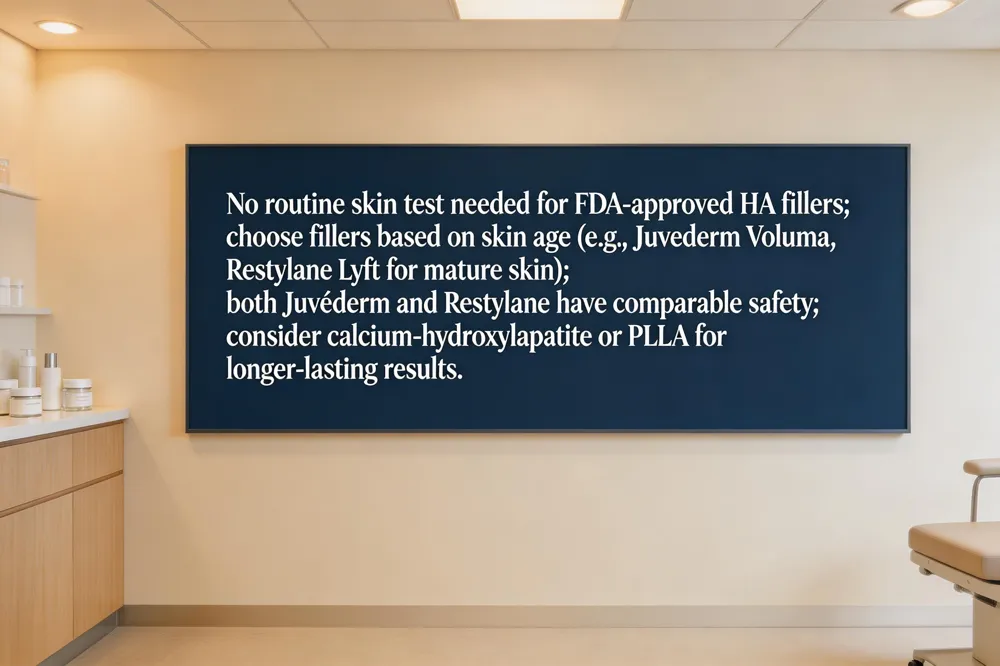
No routine skin test is required. FDA‑approved hyaluronic‑acid (HA) fillers are synthetic polysaccharides identical to the body’s natural HA, eliminating animal‑derived proteins that could trigger immediate hypersensitivity. The CDC and FDA guidelines emphasize that a thorough medical‑history review is sufficient; only patients with a documented severe allergy to HA‑based products may be considered for a precautionary test dose under physician discretion.
Do I need a skin test before receiving hyaluronic‑acid dermal fillers?
No routine skin test is required. FDA‑approved hyaluronic‑acid (HA) fillers are synthetic polysaccharides identical to the body’s natural HA, eliminating animal‑derived proteins that could trigger immediate hypersensitivity. The CDC and FDA guidelines emphasize that a thorough medical‑history review is sufficient; only patients with a documented severe allergy to HA‑based products may be considered for a precautionary test dose under physician discretion.
Which filler is best suited for older skin? For mature skin, HA fillers such as Juvederm Voluma XC and Restylane Lyft restore deep volume and integrate smoothly with facial movement, offering up to two‑year longevity and the option of hyaluronidase reversal. Calcium‑hydroxylapatite (Radiesse) provides structural support and collagen stimulation for contouring, lasting about one year. Poly‑L‑lactic acid (Sculptra) induces gradual collagen neosynthesis over months, delivering long‑lasting rejuvenation up to two years. The optimal choice depends on the patient’s specific concerns—volume loss, deep folds, or overall texture—and should be individualized by a board‑certified aesthetic physician.
Is Juvéderm safer than Restylane, or vice‑versa? Both are FDA‑approved HA fillers with comparable safety profiles when administered by trained clinicians. Restylane has a longer market history, while Juvederm’s Vycross technology may produce a smoother gel and slightly less swelling. Large‑scale surveillance shows no statistically significant difference in serious adverse events. Thus, safety is equivalent; product selection should be guided by treatment area, desired durability, and injector experience rather than inherent safety superiority.
Putting Safety First for Optimal Aesthetic Results
Before any Botox or dermal filler session a screening questionnaire is completed, mirroring CDC injection‑safety standards such as hand hygiene, aseptic preparation, and the “One Needle, One Syringe, Only One Time” rule. The clinician verifies the patient’s medical history, medication list—including anticoagulants and herbal supplements—pregnancy status, and any active skin infections. Only FDA‑approved, single‑dose vials or pre‑filled syringes from manufacturers are used, and each needle and syringe is discarded after use. Choosing a board‑certified dermatologist or plastic surgeon who follows ASDS and USP <797> protocols guarantees technique and authenticity. Post‑procedure, patients are instructed to avoid alcohol, NSAIDs, and vigorous exercise for 24‑48 hours, apply cold compresses, keep head elevated, and monitor for infection or vascular compromise—steps that preserve results and reduce complications.