Introduction to Modern Vascular Laser Therapy
Selective photothermolysis underlies all vascular laser work: a laser wavelength that matches a chromophore (hemoglobin, water) is delivered in a pulse shorter than the vessel’s thermal relaxation time, heating the target vessel while sparing surrounding skin. Today’s key platforms include pulsed‑dye lasers (585‑595 nm) for superficial telangiectasias, KTP 532 nm for fine capillaries, and long‑pulse Nd:YAG 1064 nm for deeper or darker vessels. Fractional CO₂ and Erbium:YAG lasers address lymphatic malformations, while picosecond and hybrid systems (e.g., Fotona’s SP Line, Aerolase’s Neo) expand safety and efficacy across Fitzpatrick types. In Troy, Michigan, clinics such as North Oakland Plastic Surgery, ASMD Aesthetics, and Youn Plastic Surgery employ these FDA‑cleared devices with real‑time cooling, AI‑guided parameter selection, and individualized protocols, ensuring minimal downtime, high clearance rates, and optimal outcomes for local patients.
Cost Landscape and Pricing Transparency
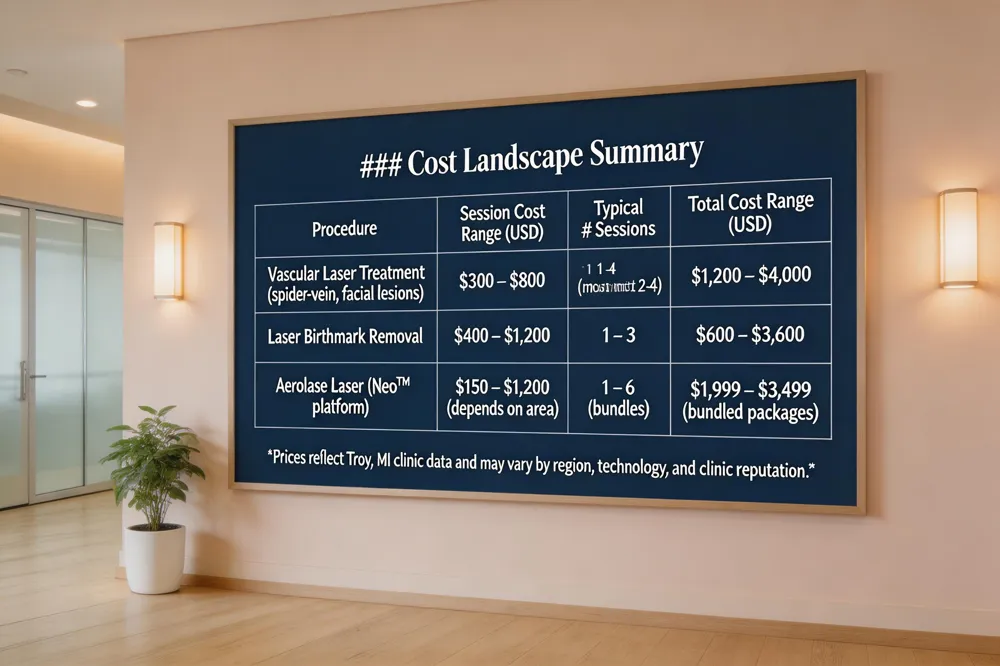
Cost Landscape Summary
| Procedure | Session Cost Range (USD) | Typical # Sessions | Total Cost Range (USD) |
|---|---|---|---|
| Vascular Laser Treatment (spider‑vein, facial lesions) | $300 – $800 | 1 – 4 (most 2‑4) | $1,200 – $4,000 |
| Laser Birthmark Removal | $400 – $1,200 | 1 – 3 | $600 – $3,600 |
| Aerolase Laser (Neo™ platform) | $150 – $1,200 (depends on area) | 1 – 6 (bundles) | $1,999 – $3,499 (bundled packages) |
Prices reflect Troy, MI clinic data and may vary by region, technology, and clinic reputation.
Vascular Laser Treatment Price
In the United States, vascular laser treatments generally cost between $300 and $800 per session. Typical spider‑vein or facial vascular lesions are priced at $300 – $400 for a single visit, while larger or deeper lesions may reach $500 – $1,200 in metropolitan areas. Prices vary according to the size and number of vessels treated, the laser technology used (e.g., Nd:YAG, IPL, V‑Beam), and the clinic’s location and reputation. Most patients need 1 to 3 sessions for optimal cosmetic results; some cases require 2 to 4 sessions. Because these procedures are cosmetic, they are usually paid out‑of‑pocket, with insurance covering only documented medical necessity.
How Expensive Is Vascular Laser Treatment?
Overall expense depends on the number of sessions and the technology employed. A complete treatment plan often totals $1,200 to $4,000, reflecting the per‑session range and the typical 2‑to‑4 appointments needed. Advanced laser systems and larger treatment areas increase the price, while providers in Troy, Michigan may fall toward the lower end of the national range due to regional cost differences. Financing options such as CareCredit are frequently offered to make the investment more manageable.
Laser Birthmark Removal Cost
In Michigan, laser removal of a single birthmark generally costs $400 – $1,200 per session, depending on size, depth, and laser type. Most patients achieve satisfactory clearance after 1 to 3 sessions, placing the total expense in the $600 – $3,600 range. Troy‑area clinics often provide tiered pricing, with small‑area treatments starting around $120 and full‑face packages near $330 per session. Larger or deeper birthmarks that require more advanced lasers push the price toward the higher end of the spectrum.
Aerolase Laser Price
At a Troy, Michigan clinic, an Aerolase laser session costs $250 – $600 depending on the treatment area and condition. Small areas (upper lip, chin) start at $150–$250, medium facial or neck treatments range $250–$500, and larger areas (back, legs) can be $500–$1,200 per session. Comprehensive protocols are often bundled; for example, a six‑treatment NeoSkin rejuvenation package is $3,499 (≈ $750 per session) and a six‑treatment NeoClear acne package is $1,999 (≈ $399 per session). Financing plans are typically available to ease the financial commitment.
Choosing the Optimal Laser Modality
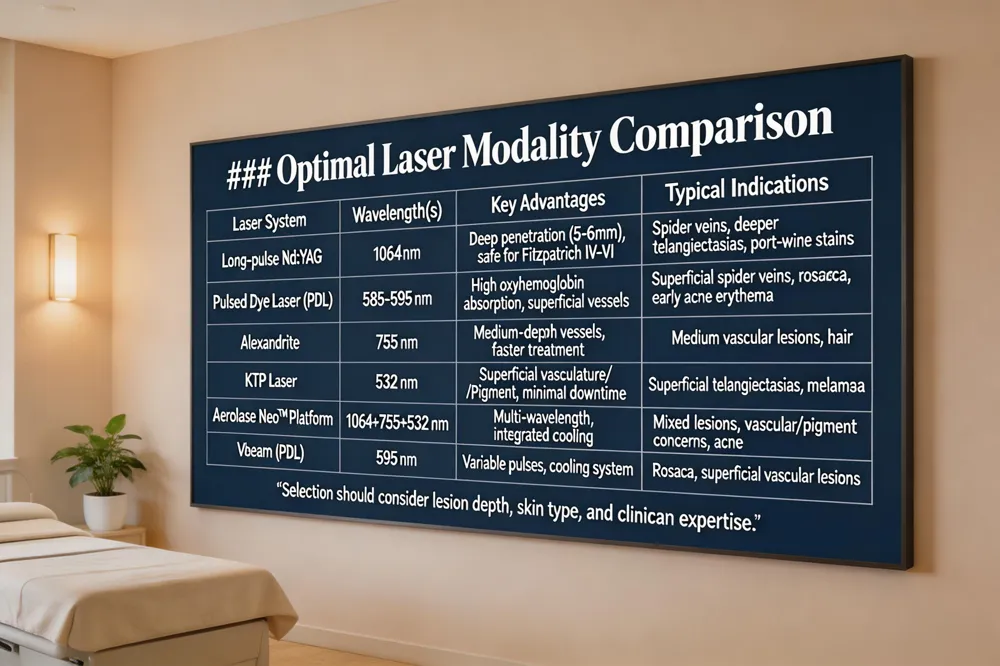
Optimal Laser Modality Comparison
| Laser System | Wavelength(s) | Key Advantages | Typical Indications |
|---|---|---|---|
| Long‑pulse Nd:YAG | 1064 nm | Deep penetration (5‑6 mm), hemoglobin selective, safe for Fitzpatrick IV‑VI | Spider veins, deeper telangiectasias, port‑wine stains |
| Pulsed Dye Laser (PDL) | 585‑595 nm | High absorption by oxyhemoglobin, excellent for superficial vessels | Superficial spider veins, rosacea, early acne erythema |
| Alexandrite | 755 nm | Strong absorption, good for medium‑depth vessels, faster treatment | Medium‑depth vascular lesions, hair removal |
| KTP Laser | 532 nm | Targets superficial vasculature & pigment, minimal downtime | Superficial telangiectasias, teleasma |
| Aerolase Neo™ Platform | 1064 nm (Nd:YAG) + 755 nm (Alexandrite) + 532 nm (KTP) | Multi‑wavelength, ultra‑short pulses, integrated cooling, rapid treatment | Mixed‑type lesions, pigmented & vascular concerns, acne |
| Vbeam (PDL) | 595 nm | Variable pulse widths, cooling system, well‑established safety profile | Rosacea, superficial vascular lesions |
Selection should consider lesion depth, skin type, and clinician expertise.
 Long‑pulse Nd:YAG lasers (1064 nm) are widely regarded as the gold‑standard for vascular lesions. Their 5‑6 mm penetration depth selectively coagulates oxyhemoglobin while sparing surrounding tissue, making them effective for spider veins, telangiectasias, and deeper malformations. Modern platforms—such as the Fotona SP Line and the M22 Nd:YAG system—incorporate Variable Square Pulse (VSP) technology and dynamic cooling, allowing higher fluences with minimal epidermal injury across all Fitzpatrick skin types.
Hybrid and multi‑wavelength platforms expand treatment versatility. Combining a pulsed dye laser (PDL, 585‑595 nm) for superficial vessels with a long‑pulse Nd:YAG for deeper components, or integrating Alexandrite (755 nm) and KTP (532 nm) wavelengths, enables simultaneous address of mixed‑type lesions in a single session. This approach reduces the total number of visits and improves clearance rates for complex vascular anomalies.
Aerolase technology offers a high‑speed, multi‑wavelength solution. The Neo™ platform delivers 1064 nm Nd:YAG and 755 nm Alexandrite pulses with proprietary A‑Mode and DualPulse technologies, achieving selective photothermolysis with ultra‑short pulse durations. Integrated cooling and pulse‑stacking minimize discomfort and downtime, making Aerolase suitable for both vascular and pigmented concerns.
What is the best laser treatment for vascular lesions?
Long‑pulse Nd:YAG lasers (1064 nm) are considered the gold‑standard because they penetrate deeply, target hemoglobin selectively, and, with advanced pulsing and cooling, produce high clearance rates for a wide range of vascular lesions.
What kind of laser is Aerolase?
Aerolase is a state‑of‑the‑art, multi‑wavelength aesthetic laser system that operates at 1064 nm (Nd:YAG), 755 nm (Alexandrite), and 532 nm (KTP). Its rapid, high‑peak‑power pulses and integrated cooling provide effective treatment of vascular, pigmented, and textural concerns with minimal downtime.
Who is not a candidate for Vbeam?
Patients with very dark skin (Fitzpatrick V–VI), active infections, recent tanning, isotretinoin use within six months, photosensitizing medications, blood thinners, high‑dose vitamin E, NSAIDs/aspirin, or those who are pregnant/nursing are generally contraindicated for Vbeam treatment.
Safety, Side Effects, and Drawbacks
Safety & Side‑Effect Overview
| Potential Side Effect | Frequency | Management / Mitigation |
|---|---|---|
| Transient erythema, swelling, bruising | Common (≥ 70 %) | Cool compresses, topical anti‑inflammatories, sun protection |
| Hyper‑ or hypopigmentation (temporary) | Moderate (10‑30 %) | Avoid excessive fluence, pre‑treat with topical bleaching agents, monitor skin tone |
| Blistering or crusting | Rare (< 5 %) | Adjust fluence, ensure proper cooling, post‑procedure wound care |
| Infection | Very rare (< 1 %) | Aseptic technique, prophylactic antibiotics if indicated |
| Scarring or tissue necrosis | Very rare | Use appropriate settings, avoid over‑treatment, follow‑up for early intervention |
| Contraindications (e.g., active infection, isotretinoin, anticoagulants) | N/A | Thorough medical history, pause offending meds, postpone treatment if needed |
Overall, laser therapy is safe when performed by trained professionals with proper patient selection.
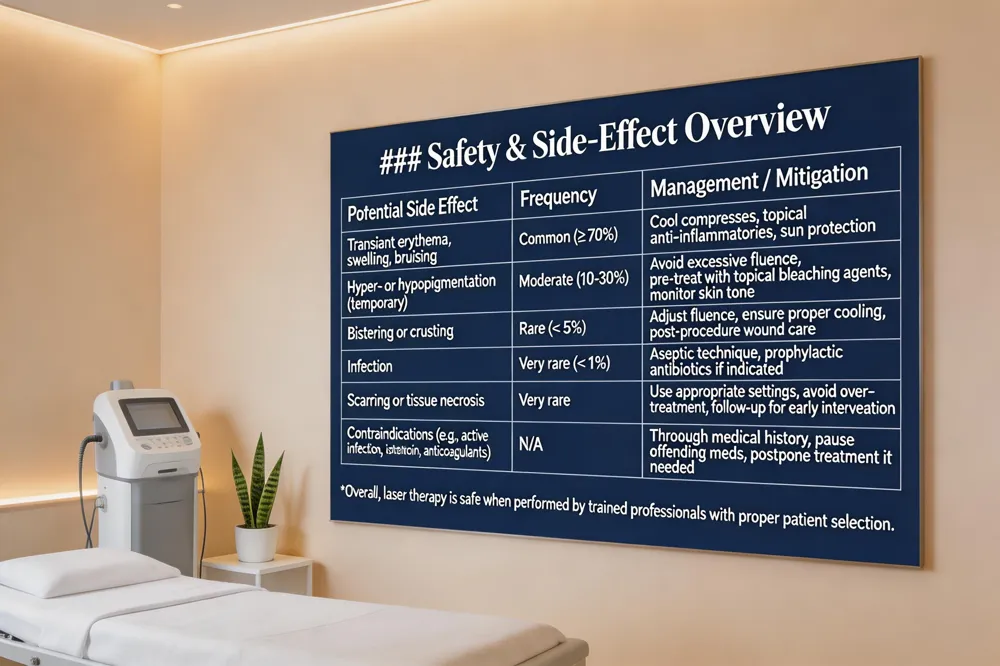 Laser removal of vascular lesions follows the principle of selective photothermolysis, which makes safety largely predictable when performed by trained clinicians. Immediate and delayed reactions are usually mild: patients experience transient erythema, swelling, bruising, and a brief “elastic‑band” sensation that resolve within a few days. Darker Fitzpatrick skin types may develop temporary hyper‑ or hypopigmentation that fades over weeks to months. Rare complications include blistering, crusting, infection, superficial thrombophlebitis, nerve tingling, or scarring when fluence is excessive or after‑care is inadequate.
Contraindications and patient selection are critical. Active infections, uncontrolled diabetes, recent isotretinoin use, anticoagulant therapy, and photosensitivity disorders increase risk. Patients on systemic agents such as sirolimus or MEK inhibitors should pause therapy around the procedure to protect wound healing. Fitzpatrick skin types IV‑VI benefit from longer‑wavelength Nd:YAG lasers, while lighter skin can tolerate short‑pulse PDL or KTP wavelengths.
Limitations of laser therapy include the need for multiple sessions—often 3‑5—to achieve optimal clearance, raising cost and time commitment. Deep or high‑flow malformations may require adjunctive sclerotherapy, embolization, or surgery because laser penetration is limited to 5‑6 mm for most devices.
What are the side effects of laser vascular lesion removal? The most common are mild redness, swelling, bruising, and a brief discomfort that subside within days; pigment changes and, rarely, scarring or infection can occur.
What are two drawbacks of laser therapy? It demands several treatment visits, increasing expense and time, and carries a risk of side‑effects such as pigment alteration, swelling, or scarring, especially in darker skin or with aggressive settings.
Is 70 too old for laser resurfacing? No. Healthy patients in their 70s can undergo laser resurfacing with tailored, gentler settings—non‑ablative or low‑fluence ablative lasers—provided they have realistic expectations and no contraindicating medical conditions.
Targeted Protocols for Specific Lesions
Targeted Laser Protocols
| Lesion Type | Preferred Laser / Wavelength | Typical Sessions | Expected Clearance % |
|---|---|---|---|
| Superficial spider veins / telangiectasias | Pulsed Dye Laser (PDL) 585‑595 nm | 2 – 4 | 70‑90 % |
| Deeper vascular malformations | Long‑pulse Nd:YAG 1064 nm | 3 – 5 | 60‑80 % |
| Mixed‑type lesions (vascular + pigmented) | Hybrid (PDL + Nd:YAG) or Aerolase (1064 nm + 755 nm) | 2 – 4 | 75‑95 % |
| Birthmarks (port‑wine, hemangioma) | Nd:YAG 1064 nm or PDL (depending on depth) | 1 – 3 | 70‑90 % |
| Early stretch marks (vascular) | Nd:YAG 1064 nm | 3 – 4 | 30‑50 % improvement |
| Mature stretch marks (fibrotic) | Fractional CO₂ or Picosecond laser | 3 – 4 | 20‑40 % improvement |
Individual results may vary based on lesion size, depth, and skin type.
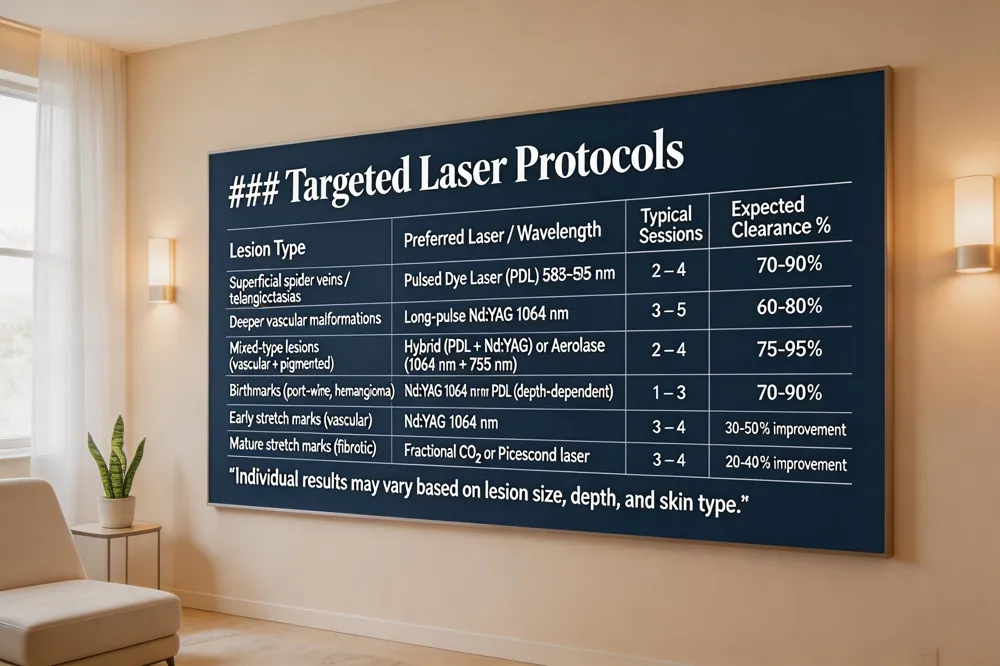 Laser therapy offers precise, non‑invasive solutions for a range of skin concerns, and the choice of device and protocol is tailored to each lesion type and patient.
Laser treatment for melasma before and after – Melasma appears as brown‑gray patches on the cheeks, forehead, or upper lip. Fractional or picosecond lasers break down melanin and stimulate uniform skin renewal. Most patients notice significant lightening after 3‑6 sessions, with smoother, more even tone. Results are sustained with diligent sunscreen use and, when appropriate, topical lightening agents.
Laser therapy for birthmarks near me – Our Troy, MI clinic uses state‑of‑the‑art lasers—pulsed‑dye, Nd:YAG, IPL, or hybrid fractional systems—to treat port‑wine stains, hemangiomas, café‑au‑lait spots, and other pigmented lesions. Individualized consultation determines the optimal wavelength and settings, ensuring minimal downtime and gradual fading. Contact (248) 267‑5020 to schedule a visit.
Is it safe to remove birthmarks with laser? – Yes. When performed by board‑certified specialists, lasers selectively target pigment or vascular chromophores, sparing surrounding tissue. Side effects are typically mild (temporary redness, swelling, crusting) and manageable with proper after‑care. Most patients achieve 70‑90 % lightening safely.
How to get rid of vascular birthmarks? – Treatment depends on type, size, and depth. Infantile hemangiomas often start with oral or topical propranolol. Pulsed‑dye (PDL) and Nd:YAG lasers address superficial and deeper lesions, while sclerotherapy or surgical excision may be needed for larger malformations. A personalized plan ensures optimal cosmetic outcome.
Vascular laser for stretch marks – Early, pink‑red stretch marks respond to 1064‑nm Nd:YAG, which reduces vascular redness. Mature, white stretch marks benefit more from fractional CO₂ or picosecond lasers combined with collagen‑stimulating modalities such as RF or microneedling. A series of three to four spaced sessions yields the best improvement with minimal downtime.
Future Directions and Emerging Aesthetic Treatments
Emerging Trends for 2026
| Trend | Description | Clinical Impact |
|---|---|---|
| Regenerative Injectables & Skin‑Boosters | Polynucleotides, nanofat‑PRP blends, poly‑L‑lactic‑acid biostimulators, micro‑droplet HA fillers | Stimulate collagen/elastin, provide natural volumization, prolong results of laser procedures |
| AI‑Driven Laser Parameter Selection | Real‑time imaging + machine‑learning algorithms adjust fluence, pulse duration, spot size based on vessel size, depth, skin type | ↓ Adverse events up to 20 %, ↑ clearance rates, personalized treatment plans |
| Hybrid Energy‑Based Combos | Simultaneous/Sequential use of PDL, Nd:YAG, fractional CO₂, RF microneedling | Treat pigment & vasculature in one session, multi‑layer rejuvenation, longer lasting outcomes |
| Ultra‑Fast Multi‑Wavelength Platforms (e.g., Aerolase Neo™) | Integrated 1064 nm, 755 nm, 532 nm with A‑Mode/DualPulse and cooling | Reduced treatment time, broader lesion coverage, minimal downtime |
| Personalized Post‑Care Regimens via Tele‑Dermatology | Remote monitoring, AI‑guided after‑care advice | Improves compliance, early detection of complications, enhances patient satisfaction |
These innovations aim to increase efficacy, safety, and patient convenience in aesthetic laser medicine.
 The 2026 aesthetic landscape is being reshaped by three converging trends. First, regenerative injectables and skin‑boosters such as Polynucleotides, nanofat‑PRP blends, Sculptra, and hyaluronic‑acid micro‑droplet fillers (e.g., Skinvive™) provide intra‑tissue collagen and elastin stimulation while delivering natural volumization. Second, AI‑driven laser parameter selection is moving from research to clinical practice: real‑time imaging and machine‑learning algorithms now analyze vessel size, depth, and skin type to auto‑adjust fluence, pulse duration, and spot size, reducing adverse events by up to 20 % and improving clearance rates for vascular lesions. Third, hybrid energy‑based combos—simultaneous or sequential use of pulsed dye laser (PDL), Nd:YAG, fractional CO₂, and radio‑frequency microneedling—allow clinicians to treat both superficial pigment and deeper vasculature in a single session, delivering multi‑layer results that last months to years.
What are the new aesthetic treatments for 2026? Regenerative aesthetics dominate, with injectable Polynucleotides, advanced skin‑boosters, nanofat‑PRP, poly‑L‑lactic‑acid biostimulators, and micro‑droplet HA fillers providing collagen‑stimulating volumization. Energy‑based devices such as RF microneedling (Morpheus8), laser‑tightening, and infrared “Invisilift” reshape dermis, while strategic stacking of injectables with these energies yields durable, natural outcomes.
Laser treatment for melasma before and after: Before treatment, melasma appears as brown‑gray patches on the cheeks, forehead, or upper lip. Fractional or picosecond laser sessions break up melanin, prompting uniform skin renewal. Visible lightening occurs after 3‑6 sessions; final results are maintained with diligent sunscreen and topical lightening agents.
How long does it take for a laser birthmark to heal? Initial swelling and redness resolve in 1‑3 days, scabbing or temporary darkening fades over 1‑2 weeks, and most cosmetic improvement is seen by week three. Full, stable healing typically completes within 3‑4 weeks, with deeper lesions following a similar timeline per session.
Conclusion: Integrating Science, Safety, and Innovation
At our Troy clinic, every vascular‑lesion patient receives a tailored treatment plan that begins with a thorough assessment of lesion depth, vessel size, skin type, and any systemic medications. We then select the optimal wavelength—PDL for superficial telangiectasias, Nd:YAG for deeper malformations, or a combined multi‑modal protocol—using FDA‑cleared devices such as Fotona’s long‑pulse Nd:YAG and Aerolase Neo™. All parameters follow evidence‑based protocols that respect thermal relaxation time and incorporate dynamic cooling to protect the epidermis. Looking ahead, we integrate AI‑driven lesion mapping, picosecond and fractional technologies, and emerging systemic‑therapy holidays to enhance outcomes while minimizing downtime, ensuring our patients benefit from the safest, most advanced care available.